
In this article

The three best words to characterize a well-written board meeting motion are concise, specific and actionable. These qualities ensure your motion receives clear consideration without consuming excessive meeting time that growth-stage companies can’t afford to waste. These principles apply across public, private and nonprofit boards, but they are especially critical for growth-stage and pre-IPO companies where meeting time is at a premium.
For companies managing governance requirements, precise motion writing is key for board efficiency. Clear motions help bridge the gap between strategic discussion and executable decisions, especially for companies preparing for IPO or managing growth challenges. When board directors spend excessive time clarifying vague proposals, meeting time shifts away from the strategic planning that drives growth outcomes.
This guide is written for corporate secretaries, general counsel and governance leaders at growth-stage and pre-IPO companies who want to make board meetings more efficient and decision-focused.
This comprehensive guide covers:
A meeting motion is a formal proposal put forward by a voting board member during a meeting for discussion and vote. It is the mechanism boards use to structure decisions, document actions and create an official record of what was approved, rejected or tabled. Any voting board member, including the chair where permitted by your bylaws, can make a motion.
Using standardized phrasing helps ensure motions are clear and properly recorded. Common formulations include:
Consistent language reduces procedural confusion and makes minutes easier to draft, especially for governance teams managing multiple committees.
Board meetings often derail when directors spend 20 minutes debating what a motion actually asks them to approve.
Companies preparing for IPO or managing investor relations can’t afford meetings where half the time goes to clarifying poorly written proposals. The fundamentals below help you write motions that directors can understand, evaluate and vote on efficiently.
A well-planned motion clearly defines a board member’s intentions while respecting the time constraints that corporate governance leaders at growing companies face. Start by identifying the core elements that every effective motion requires:
Consider the broader implications before drafting. “Board engagement, to me, comes down to two pillars: relationship building and setting your board members up for success. It’s about helping them get what they need and making it easy for them to connect with the mission of your organization,” says April Van Epps, Chief of Staff at Centerstone.
When your motion involves funding, specify the source and amount clearly. Complex financial motions often require separate supporting motions for budget allocation.
“New board members are often coming from a role as an executor, and they’re not used to leading from a strategic point of view. But board members must think through things strategically and not get lost in the details,” says Jim Myers, Deputy General Counsel, Corporate Governance at Fannie Mae.
Motions that include clear strategic rationale help directors stay at the right altitude during discussions.
Remember that while you understand your motion's background, fellow directors may encounter these details for the first time. According to the APAC Governance Outlook 2026 by Diligent Institute, Governance Institute of Australia and Singapore Institute of Directors, 63% of governance leaders believe boards should carve out more time for strategic discussions. Clear motions that eliminate clarification questions are one of the most effective ways to reclaim that time.
Read your motion aloud to ensure it requests specific action within a defined timeframe. “Giving the information in advance helps board members better prepare,” notes Catherine Hill, Executive Secretary at Vigo County School Corporation.
A systematic approach to motion writing ensures consistency, reduces preparation time and minimizes meeting delays.
Clearly define what board action you need. Determine whether the decision requires full board approval or can be delegated to a board committee. Consider timing constraints and regulatory deadlines that may influence the motion’s urgency and scope.
Collect all relevant data before drafting, including financial implications, legal requirements and implementation resources. For companies preparing for IPO, ensure you understand any public company implications or investor relations considerations.
Brief relevant executives, committee chairs or subject matter experts before drafting. This pre-work helps identify potential objections and builds support for your proposal. Early consultation reduces the likelihood of amendments during board meetings.
Structure your motion using the core elements: specific action requested, responsible parties, clear timeline, budget parameters (if applicable) and context for informed voting. Keep the motion to 1-3 sentences.
Review your draft for legal compliance, regulatory requirements and operational feasibility. For companies using governance platforms, run materials through risk management tools to identify potential compliance issues before board presentation.
Circulate the draft motion to relevant stakeholders, including legal counsel, CFO or committee chairs, for feedback. This review ensures accuracy, identifies missing information and confirms that proposed timelines and budgets are realistic.
Complete your final motion and integrate it into board materials with appropriate supporting documentation. Schedule any necessary pre-meeting discussions with key directors to address complex aspects.
Motion writing sits within the wider cadence of board preparation. If you're refining that broader prep rhythm, our board meeting preparation checklist template gives you a repeatable sequence for organizing materials, surfacing key decisions early and keeping the board ahead of regulatory deadlines.
While Robert’s Rules of Order describe several classes and sub-types of motions, most boards regularly work with four main categories, each serving different purposes in board decision-making. Understanding these types helps you choose the right approach for your proposal and navigate situations where multiple motions interact during meetings.
Main motions: This is the most common type of board meeting motions. The purpose of a main motion is to ask the board to take a specific action. Board members may not introduce a main motion when another motion is already on the floor. In most boards that follow Robert’s Rules, main motions require a second before discussion begins.
Subsidiary motions: These motions can modify how main motions are handled. For example, if a director proposes removing an underperforming board member, another director might move to enter executive session for a sensitive discussion. The board votes on the subsidiary motion first, then may vote to dismiss or delay the main motion.
Privileged motions: These address urgent or special matters unrelated to pending business during the meeting. These motions usually take precedence over other business and are often undebatable, depending on your board’s rules and how closely they follow Robert’s Rules. For example, if urgent matters will take more time than reasonably possible during a regular meeting, a board member may move to set a date and time for the next meeting.
Incidental motions: Incidental motions deal with procedural questions that arise out of other motions or business, such as requesting clarification, raising a point of order or asking how a motion should be handled procedurally. These must be considered first, before the motion they question.
Well-written motions address the specific governance challenges that mid-market companies face today. These fictional examples below demonstrate how to structure clear, actionable proposals for common board decisions:
"Recent cybersecurity incidents in our industry and SEC disclosure expectations mandate enhanced incident response capabilities. Our current manual reporting processes cannot meet the four-business-day materiality reporting deadline for material cybersecurity incidents that require Form 8-K reporting. I move to direct the audit committee to engage a qualified third-party cybersecurity firm to conduct a comprehensive security assessment by June 30, 2026, and establish automated incident detection and reporting protocols, with implementation costs not to exceed $125,000 from the existing compliance budget."
"To maintain competitive talent retention during our pre-IPO phase and align with institutional investor expectations, I move to engage Pearl Meyer & Partners to conduct an executive compensation benchmarking study against public company peers in our sector, with results and recommendations presented to the compensation committee by August 15, 2026, at a cost not to exceed $75,000 from the professional services budget."
"Given our planned IPO filing in Q2 2027 and SOX compliance requirements, I move to expand the board from seven to nine directors and direct the nominating committee to identify and recruit two independent directors with public company audit committee experience, with candidate presentations to the full board completed by September 30, 2026."
"The proposed acquisition of DataTech Solutions aligns with our platform strategy and accelerates our enterprise market entry by 18 months. I move to authorize management to proceed with due diligence and negotiate definitive terms for the acquisition at a purchase price not to exceed $50 million, with final transaction approval subject to board review of completed due diligence findings."
Each motion clearly states what action is requested, who is responsible, when completion is expected and what resources are required. This specificity allows directors to vote confidently without extended clarification.
Knowing how to write a good motion is only half the challenge. Companies need systematic approaches to ensure consistent quality, maintain proper documentation and track implementation progress. These practices become especially critical when preparing for an IPO or managing investor relations, where governance processes face increased scrutiny.
Create standardized formats for common motion types, including budget approvals, committee assignments and policy changes. This consistency reduces preparation time while ensuring all necessary information appears in familiar locations.
Maintain comprehensive records of all motions, including status, amendments and implementation progress. This creates audit trails supporting regulatory compliance and board effectiveness measurement.
Motions should be recorded in meeting minutes with exact wording, the outcome of the vote and key details such as who made and seconded the motion. Using a board portal or dedicated minute-taking tool ensures that motion status and implementation progress are tracked consistently across meetings.
Include sufficient background information for informed voting without overwhelming directors with excessive detail. Focus on business rationale, regulatory requirements and strategic implications relevant to your company’s growth stage.
Specify implementation deadlines and follow-up reporting requirements to ensure progress tracking.
Evaluate whether your motion’s scope matches available resources and timeline constraints. Ensure your organization has the necessary expertise, budget and bandwidth to deliver on the proposed timeline. Overly ambitious motions that exceed realistic implementation capacity often lead to delayed execution and board frustration.
Building on these foundational practices, AI-powered governance tools are transforming how companies create, review and manage board motions.
Automate board and committee meeting creation while enhancing collaboration with secure, integrated governance

Technology is streamlining motion preparation and meeting efficiency for growth-stage companies. AI-powered tools address the information asymmetry between management and boards by enabling directors to interact directly with comprehensive data rather than relying on summarized reports.
“Preparing materials digitally now cuts our time by 75%, a process that used to take a full day. The simplicity of building meeting books ‘as you go’ eliminates the need to wait until everything is together to make a copy or scan a PDF,” says Elizabeth Thompson, Executive Assistant to the President, Corporate Secretary and Corporate Compliance Officer at Presbyterian SeniorCare Network.
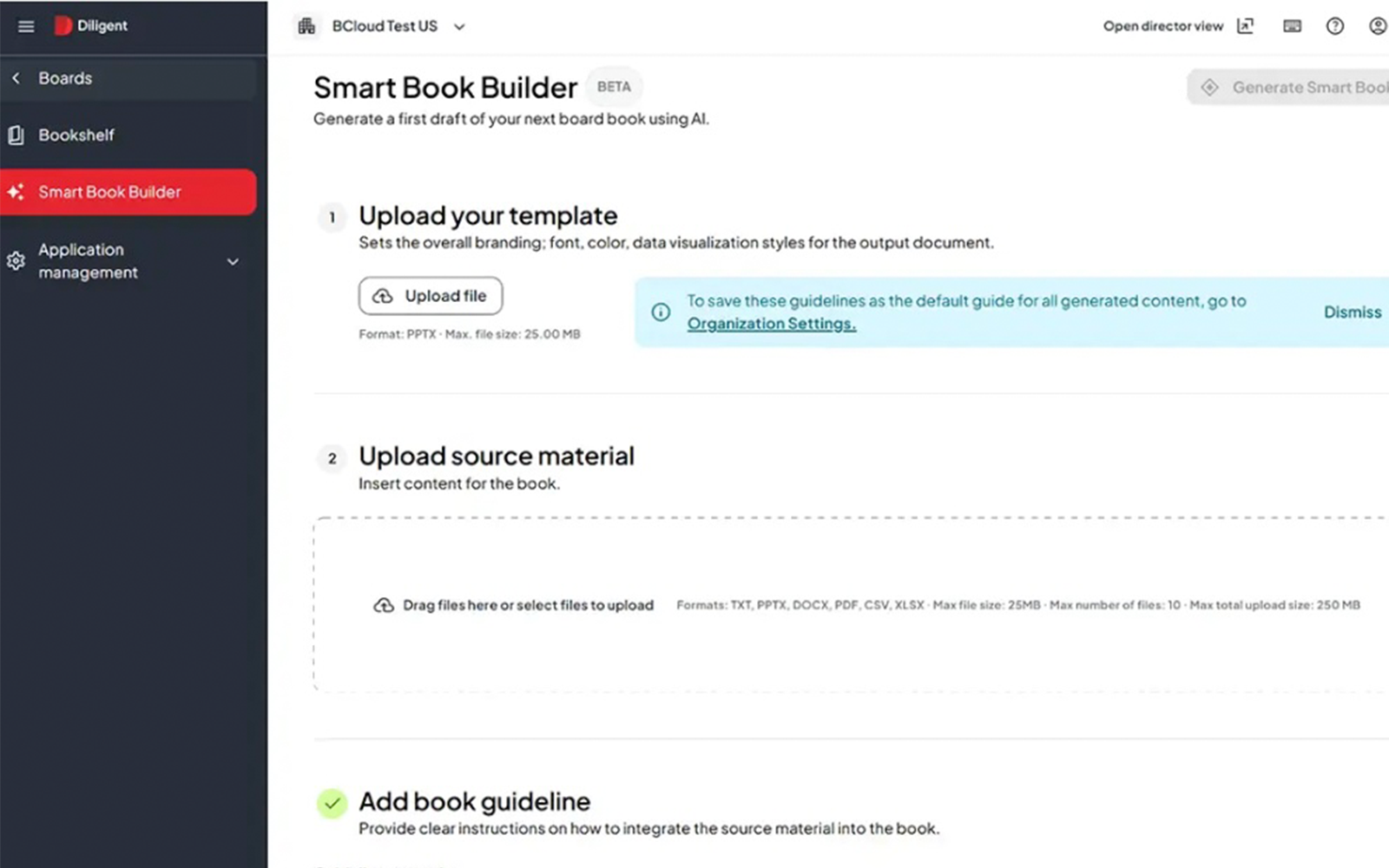
Streamlined document creation: Diligent’s Smart Builder synthesizes complex information into professional board materials with one click, allowing governance teams to focus on crafting precise motions rather than spending weeks on document preparation. This capability proves particularly valuable for companies preparing for funding rounds or managing transaction readiness requirements. It can also assemble motion-relevant materials like draft resolutions, background memos and risk summaries so directors see everything in context.
Enhanced preparation intelligence: SmartPrep generates tailored discussion questions and meeting insights, helping board members understand context before meetings begin. This reduces clarification time during actual board discussions.
Risk-aware decision support: The Smart Risk Scanner identifies potential legal and compliance implications before motions reach the board, ensuring proposals comply with regulatory requirements and corporate governance standards. Governance teams can run draft board books and resolutions through Smart Risk Scanner to identify regulatory, contractual or policy conflicts before motions go to the board. For companies preparing for public company transition, this proactive risk identification proves essential.
Effective board motions serve as the foundation for efficient governance and strategic decision-making. By focusing on the core elements of clarity, specificity and actionability, boards can transform time-consuming clarification discussions into productive strategic conversations.
When combined with AI-powered tools like Diligent’s Smart Builder and SmartPrep, the practices outlined in this guide enable boards to maintain high governance standards while accelerating decision-making timelines.
Ready to streamline your board governance processes? Schedule a demo to see how Diligent can transform your motion preparation and board meeting efficiency.
A meeting motion is a formal proposal made by a voting board member that is discussed, potentially amended and then voted on by the board. Motions are the primary mechanism for structuring board decisions and creating an official record of approved actions. They can range from routine budget approvals to complex strategic authorizations.
A well-written motion should be concise enough to read aloud in 30-60 seconds while containing all essential information for informed voting. This typically translates to 1-3 sentences clearly stating the proposed action, relevant context and specific timelines or parameters.
Every effective motion requires: the specific action being requested, identification of responsible parties for implementation, relevant deadlines or timelines and sufficient context for directors to understand business rationale. If funding is required, specify the source and amount.
Yes, main motions can be amended during board meetings through subsidiary motions, provided amendments relate to the original motion’s purpose. Amendments follow the same second, debate and vote pattern as the original motion. However, extensive modifications during meetings often indicate insufficient preparation.
Without a second, motions die immediately and no vote occurs. This typically indicates insufficient support or unclear language. Consider revising the motion’s scope, providing additional context or conducting an informal discussion with fellow directors before reintroducing. Note that some small boards or alternative rule sets may waive the second requirement entirely.
Complex motions should generally be separated into focused, independent motions that can be voted on individually. This approach provides clearer decision trails and allows partial approval of multi-part proposals. Use supporting documentation to show relationships between related motions while maintaining voting clarity.
Book a Diligent demo to transform your board meeting efficiency with AI-powered governance tools.