

In this article

Corporate and company laws in many jurisdictions require companies to keep records of shareholder and director meetings, and even where minutes are not explicitly mandated, maintaining them is considered a core governance best practice. Most developed markets mandate documentation — from the UK’s Companies Act requirements to Australia’s Corporations Act provisions. Growing companies often discover these obligations during their first serious funding round, when investors request years of governance documentation that simply doesn’t exist.
Your company feels this friction directly. Funding rounds stall when investors can’t verify past decisions. Acquirers reject deals when corporate records look unprofessional. According to the Transaction Readiness Report by Diligent Institute and its research partners, senior leaders rate their confidence in transaction readiness at just 5.7 out of 10, a gap that surfaces quickly during due diligence.
This guide is designed for corporate secretaries, general counsel and founders at growing companies who need investor-ready corporate meeting minutes.
Here, we’ll explain how to take effective corporate meeting minutes, including:
Corporate meeting minutes (also called corporation minutes or corporate minutes) are the official written record of important discussions and decisions made at shareholder, director and management meetings. They document what was decided, why it mattered and who approved each action, forming part of the corporation’s legal and governance record.
These records differ from board meeting minutes in that they document meetings held by corporate managers and executives rather than by the board of directors. A secretary or acting secretary usually takes the minutes, but the task can be delegated. Corporate minutes serve three fundamental purposes:
“Governance is like an iceberg. The part that fits above the water is what most people see. That includes board meetings, your board directors, your agenda and your minutes. But below the surface is where the complexity lives, like risk, audit, compliance, legal entity management, legal operations,” — Brian Stafford, CEO of Diligent.
When scaling from founder-led meetings to formal governance, understanding the distinction between corporate minutes and board minutes prevents documentation gaps.
As your company grows, these distinctions become critical for transaction readiness. Investors request management records to verify operational decisions, while acquirers examine board and shareholder minutes for evidence of proper oversight and formal corporate actions.
The short answer: Almost always. Shareholder and board meetings require formal minutes under corporate law in most jurisdictions. Committee meetings are also typically documented, particularly for audit, compensation and governance committees. Even where statutes are lighter, minutes for material management decisions, especially those affecting capital structure, executive compensation, tax elections or major contracts, are strongly recommended.
LLC and partnership rules differ from corporate requirements, but minutes are still advisable for tax and liability reasons. Consistent documentation helps protect limited liability status regardless of entity structure.
“We were going to get to the point where we were operating like a public company before we were a public company. Doing earnings calls, having the SOX compliance processes and so on,” says Don Song, Senior Corporate Counsel at Klaviyo.
While statutes typically focus on shareholder and board meetings, investors and courts often look for records of key management decisions as evidence that leaders fulfilled their duties. Specific requirements vary by jurisdiction, but even where statutory requirements are lighter — like Delaware — investors, auditors and courts still expect professional records of decision-making.
United States: Most states require formal meeting documentation as part of corporate leaders’ fiduciary duties. Several states, including Delaware, Kansas, Nevada, North Dakota and Oklahoma, don’t explicitly mandate minutes, but maintaining them is best practice to preserve the corporate veil and prove formalities.
European Union: The EU’s Company Law Package requires member states to ensure proper corporate record-keeping.
Asia-Pacific: Australia’s Corporations Act and Singapore’s Companies Act both require detailed meeting minutes with specific retention periods.
Regulators and standard-setters increasingly reference governance documentation in ESG, tax and audit contexts, making robust minutes part of your broader compliance posture rather than a narrow corporate law formality. Cross-border due diligence standards from international investors expect professional meeting records regardless of local requirements.
The preparation for a corporate meeting is much the same as the process for preparing for a corporate board meeting. The meeting leader should provide notice of the meeting to the proper parties.
All shareholders should be invited to a shareholder meeting, and all board directors must be invited to board meetings. Corporate meetings are typically closed to the public. The meeting leader should prepare an agenda, add relevant reports and include a copy of the prior meeting’s minutes for approval. Meeting leaders should request a sign-off for members who can’t attend.
Corporate minutes are more than a transcription of conversations. They are a record that can hold management accountable or defend them should conflicts arise. The minute-taker must be a good listener who documents the minutes as soon as possible while details are fresh.
“After board meetings, I want to see the draft minutes as soon as possible in time after meeting, quick turnaround is important,” says Priya Cherian Huskins, SVP and Partner at Woodruff Sawyer.
Here’s a step-by-step process:
Store approved copies in secure, searchable locations that support future investor due diligence requirements.
Professional corporate meeting minutes should include: date, time and location; names of attendees and absentees; quorum confirmation; who chaired the meeting; agenda items covered; a detailed account of voting results; and time of adjournment. Note late arrivals and early departures but avoid verbatim discussions. The purpose of corporate minutes is to document important actions and decisions, not to transcribe every comment.
Here’s a standard corporate meeting minutes template:
Here is how the template looks in practice for a growth-stage company’s leadership meeting:
Velocity Systems Inc. — Management Team Meeting
November 8, 2025, at 2:00 p.m. GMT | London Office Conference Room A / Microsoft Teams Hybrid
Alex Chen, CEO, called the meeting to order at 2:05 p.m. GMT. Quorum confirmed with 5 of 6 management team members present. Absent: Lisa Park, VP Marketing (client meeting in Singapore).
Financial Update (Sarah Martinez, CFO): Q4 revenue tracking 22% above projections at £2.1M. Cash runway extended to 18 months following bridge funding. Series A preparation materials 85% complete.
Series A Preparation: Investment banking proposals reviewed from three firms. Lead investor meetings scheduled for December 2025. Board composition discussions initiated for post-funding structure.
Resolution: “Resolved, that the company engage Meridian Partners as Series A placement agent with standard 6% fee structure and monthly retainer of £15,000, effective December 1, 2025.” Proposed by Sarah Martinez, CFO. Seconded by Emma Thompson, VP Sales. Passed unanimously (5-0).
Action items: Complete due diligence data room setup (Sarah Martinez, Nov. 22); Finalize VP Marketing job specification (Alex Chen, Nov. 15); Schedule investor presentation rehearsal (Emma Thompson, Nov. 20). Meeting adjourned at 3:15 p.m. GMT.
This example demonstrates the elements that make corporate minutes investor-ready. To consistently achieve this standard, follow these proven best practices.
Corporate minutes require precision. Following tried-and-true best practices helps ensure your minutes are effective:
Knowing what to leave out is just as important as knowing what to include:
See how integrated governance tools help organizations create consistent, audit-ready meeting records that satisfy investors and regulators.

Manual processes like Word documents, email threads, shared drives, create the governance gaps that surface during funding rounds. According to What Directors Think 2026 by Diligent Institute and Corporate Board Member, 40% of directors want AI-powered technology for board work and oversight. That demand extends to meeting documentation, where speed, consistency and accuracy matter most.
Diligent Minutes generates accurate meeting documentation automatically. The platform uses AI to create a high-quality first draft from your agenda, typed notes, board materials and meeting transcripts, cutting documentation time while maintaining the consistency that auditors and investors expect.
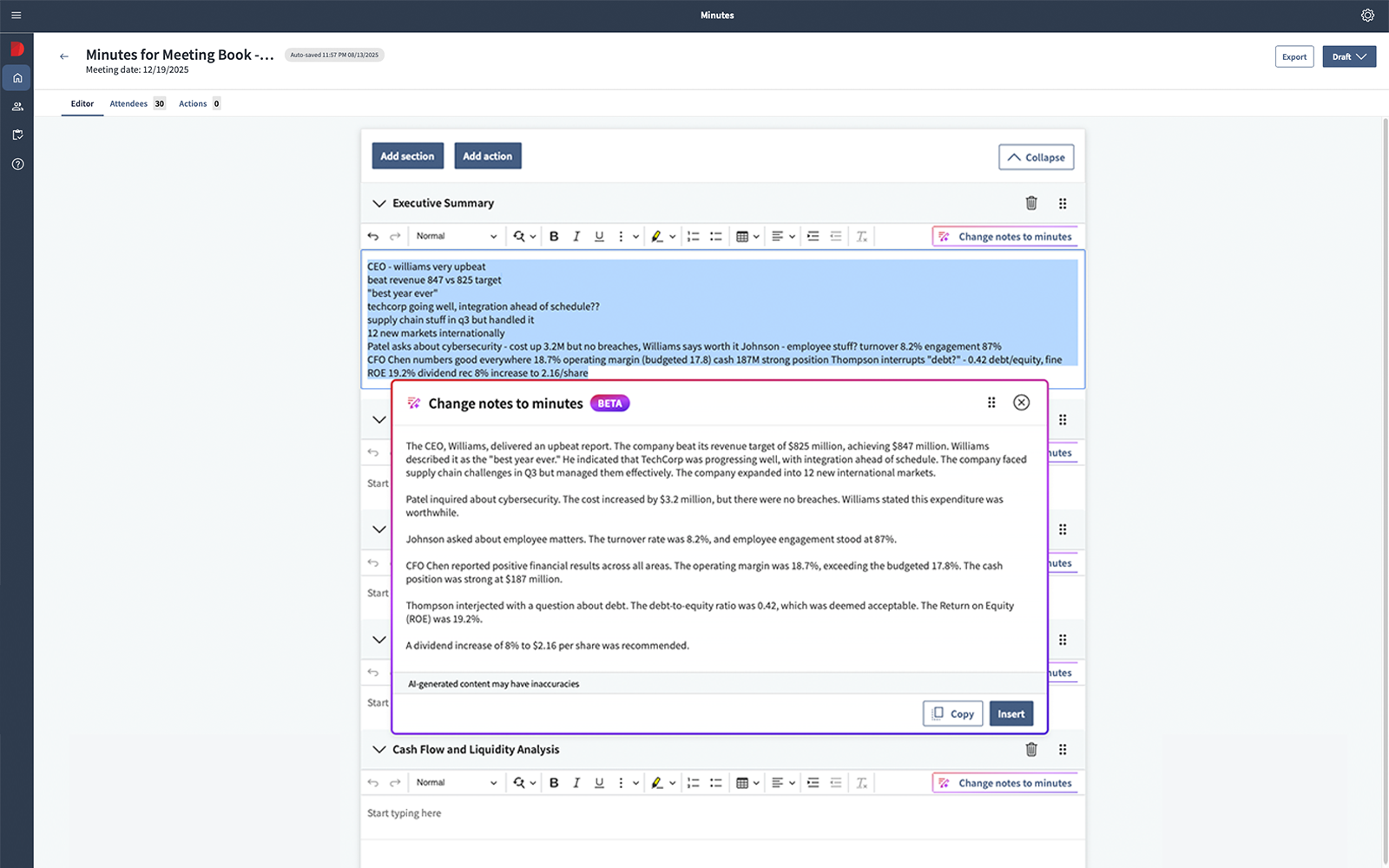
Smart Builder organizes company materials into professional board packages with consistent formatting. The Smart Risk Scanner reviews documents before distribution, identifying legal language that could create compliance issues before they reach your board or investors.
Because Diligent connects board management with entity management, risk oversight and compliance data on a single platform, governance teams get a centralized repository with audit trails and retention policies — exactly the infrastructure growing companies need during due diligence.
Corporate minutes serve as the foundation of investor confidence and legal protection that growing companies need. Whether you’re documenting your first formal leadership meeting or preparing for Series B due diligence, professional standards matter from day one.
Start with the template and best practices outlined above. When you’re ready to implement infrastructure that scales with your growth, book a demo to see Diligent in action.
Corporate meeting minutes are the official written record of decisions, votes and key discussions at shareholder, director and management meetings. They document what was decided, who approved it and why it mattered.
Shareholder and board meetings require formal minutes in most jurisdictions. Committee meetings and material management decisions should also be documented as best practice. LLC and partnership rules differ, but maintaining minutes is advisable for tax and liability protection.
Aim for an executive-summary level of detail: enough for someone to understand what was decided and why, without transcribing every comment.
Delaware’s statute does not explicitly require meeting minutes. However, maintaining them is strongly recommended for corporate veil protection, tax documentation and investor readiness.
Tools like Diligent Minutes use AI to generate a first draft from your agenda, notes, board materials and meeting transcripts. AI helps with structure and consistency, but final review and legal judgment should always remain with humans.
Ready to create investor-ready corporate meeting minutes? Schedule a demo to see Diligent in action.




