

In this article

Board meeting preparation has reached a breaking point. The average board pack now routinely exceeds 200 pages, and according to What Directors Think 2026 by Diligent Institute, 56% of directors wish their meetings focused more on forward-looking discussions rather than retrospective reporting.
How do you prepare for board meetings in a way that helps directors find what matters most? Organizations that invest in systematic preparation see faster decision-making and greater stakeholder confidence. The answer starts with a process that puts strategic insight ahead of information volume.
This guide covers everything corporate secretaries and governance teams need to streamline board meeting preparation:
Board meeting preparation is typically a collaborative effort. Corporate secretaries have a particularly critical role in preparing for board, audit and committee meetings held throughout the year, but they cannot do it alone.
Various other teams including executives, finance, HR, risk and compliance should prepare board reports, review documents to ensure they're accurate and provide the corporate secretary with the necessary input to finalize the agenda. At the same time, the IT department should work to ensure technology mishaps don't impede the meeting, while public relations prepares communication for shareholders or the public as needed.
In many large organizations, the chief of staff or executive assistant to the board absorbs much of this preparation workload when a dedicated corporate secretary function does not exist. The general counsel also plays a key role, particularly where compliance and regulatory obligations intersect with board materials.
Board meetings and the preparation they require are central to effective governance practices, which help corporations abide by state and federal laws and protect their shareholders' interests. Rigorous board meeting procedures and adequate preparation support:
Efficient decision-making: A well-prepared board meeting gives directors key reports and data ahead of the meeting. This gives directors time to review materials in advance and make more timely decisions during the meeting according to board etiquette.
Compliance: By keeping a calendar of all meetings and proactively preparing for them, the secretary ensures that the meeting is timely, relevant and complies with laws and regulations.
Proactive risk management: Preparation quality directly impacts risk identification and response capabilities. When boards receive well-structured risk assessments, they spot emerging threats early enough to act on them, shifting the organization from crisis response to proactive mitigation.
Communication: Board meeting preparation ensures that all information is clearly communicated to directors. As Inna Barmash, Chief Legal Officer and Corporate Secretary at Amplify, puts it: "The board fundamentally has to trust management. Trust starts with communication. Communication is successful when it's proactive, when it anticipates and addresses board members' concerns, and speaks to their experience from other boards and their operational experience."
Stakeholder confidence: Professional preparation signals governance maturity to institutional investors, proxy advisors and regulatory bodies. According to Diligent Institute research, director confidence reached 6.0 out of 10 in Q4 2025 after three consecutive quarters at a five-year low. In this environment, organizations that demonstrate preparation excellence earn stronger trust from their boards and stakeholders.
There's more to prepare for a board meeting than you might think. It's a best practice to take steps to prepare both digitally and operationally to ensure the meeting is successful, including:
While this list may seem extensive, adequate preparation across all these areas ensures nothing critical falls through the cracks during high-stakes board meetings. The corporate secretary's judgment call is not whether to prepare these items, but how deeply each one needs attention based on the specific meeting's agenda and any emerging issues.
Enterprise board meeting preparation requires processes that accommodate complex information gathering, stakeholder review and compliance assurance. This checklist provides actionable steps that scale across business units and maintain governance quality standards.
Immediately capture decisions, action items and follow-up requirements while discussions remain fresh. Corporate secretaries should draft preliminary minutes within 24 hours, highlighting specific commitments and regulatory obligations. Board minutes at public companies are legal documents with material consequences for regulatory compliance and director liability, so accuracy matters more than speed.
Create systematic processes for collecting reports, performance data and strategic updates throughout the board cycle. Finance teams should maintain rolling board reporting packages while business unit leaders contribute regular updates. As David Platt, Chief Strategic Development Officer at Moody's, advises: "Tell the board what they need to know, not what you know." This principle should guide what enters the information pipeline and what gets filtered out.
Collaborate with board chairs, CEOs and committee chairs to identify strategic priorities requiring board attention. Large organizations require extended timelines to accommodate complex topic preparation and cross-functional coordination.
In your agenda framework, reserve 60-70% for strategic discussions, allocate 20-25% for governance matters and limit operational updates to 10-15%. Then, schedule executive sessions for topics that require candid discussion without management present.
In practice, maintaining these allocations is one of the hardest parts of the corporate secretary's role. Committee chairs compete for agenda time, the CEO's priorities may crowd out independent director concerns and regulatory topics do not always have a natural sponsor. Build a standing agenda structure that protects time for governance and strategy, and use pre-read materials to move routine updates off the meeting floor.
Reserve meeting venues, select appropriate technology platforms and establish security frameworks. Coordinate logistical requirements across potentially global director locations and configure enterprise-grade security protocols for document access and communication.
Gather committee reports, financial analyses, competitive intelligence summaries and strategic updates from across business units. Establish clear deadlines and accountability frameworks for material contributors. This step is where preparation most commonly breaks down. Executives who do not treat board reporting as a priority create last-minute scrambles that compromise material quality.
Execute a review process to make sure materials meet governance standards and regulatory requirements. Plan for multiple review cycles to accommodate stakeholder feedback and accuracy validation.
As a quality benchmark:
For public company boards, this review phase also covers insider trading blackout period awareness and forward-looking statement review. Ensure that any projections or guidance included in board materials are clearly marked and appropriately caveated before distribution.
Complete testing of all technology systems, verify user access permissions and troubleshoot any platform issues. Test board portal functionality, configure mobile accessibility features, verify integration with enterprise systems and ensure backup systems are operational.
Distribute board packages through secure channels, enabling thorough director preparation. Current best practice from the Institute of Directors and NACD recommends distributing materials 10-14 days before meetings to allow meaningful review of complex decisions.
To achieve this:
A well-structured distribution process reduces the back-and-forth that consumes governance teams in the days before a meeting.
Confirm global director availability and technology requirements, and prepare executive session agendas and materials. Coordinate independent director discussion topics and brief committee chairs on specific oversight matters.
Execute final coordination with board leadership while completing last-minute preparations. Address any emerging issues requiring board attention and ensure presenters understand time allocations and discussion objectives. If any material changes have occurred since distribution, prepare a brief addendum rather than redistributing the full pack. Directors will appreciate clarity on what changed and why.
Preparation does not end when the meeting adjourns. The actions taken immediately afterward determine whether board discussions translate into organizational results.
Finalize and distribute minutes within 48 hours, clearly documenting decisions, dissenting opinions and assigned action items with owners and deadlines. Track action item completion between meetings so the next board cycle begins with accountability, not ambiguity.
Conduct a brief internal debrief with the governance team to identify what worked and what needs improvement in the preparation process. This feedback loop prevents the same friction points from recurring.
For compliance purposes, ensure that any items requiring external disclosure or regulatory filing are flagged and tracked separately. The gap between a board decision and its execution creates real regulatory exposure, and a disciplined follow-through process closes it.
Even experienced governance teams fall into recurring traps that undermine meeting quality. Recognizing these patterns is the first step toward eliminating them.
Discover how AI transforms board preparation and decision-making for large organizations.

According to the Director Confidence Index by Diligent Institute, only 10% of directors say AI is fully embedded in their oversight processes, even though 40% believe AI-powered technology would improve their work. AI-powered platforms address the preparation challenges documented above around efficiency, information quality and compliance oversight that manual processes cannot resolve at scale.
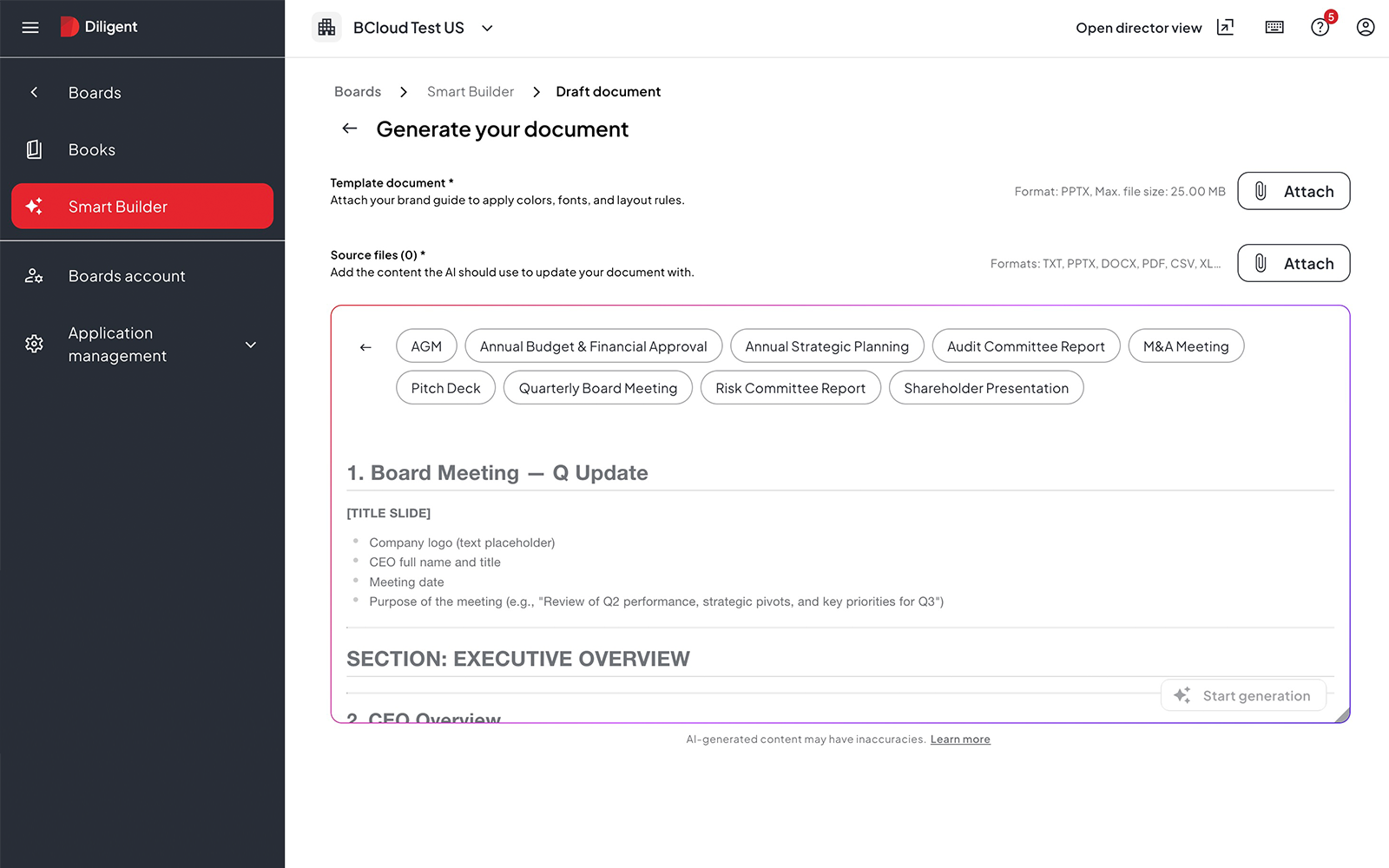
AI-powered document creation transforms how large organizations build board materials from multiple business units and data sources. These systems analyze organizational priorities and outstanding action items to automatically generate first drafts.
Diligent's Smart Builder eliminates manual board book compilation. Instead of spending days gathering and formatting documents from multiple business units, corporate secretaries generate professional board materials in hours. This directly addresses the information overload challenge by curating content that surfaces what directors need to see.
The result is a preparation workflow built around refinement rather than assembly. For organizations managing multiple committees and subsidiary boards, this automation compounds across every meeting cycle.
AI-powered risk scanning provides automated review of board materials for potential legal, regulatory and compliance issues before distribution. Diligent's Smart Risk Scanner flags regulatory concerns, data security issues and governance gaps before materials reach directors. This proactive identification helps organizations address potential issues during preparation rather than discovering problems during meetings.
Diligent's SmartPrep analyzes board materials and organizational context to generate targeted questions and surface the strategic themes that warrant board attention. Rather than reviewing static documents, directors receive AI-generated analysis highlighting key themes and strategic implications.
As Jim Myers, Deputy General Counsel of Corporate Governance at Fannie Mae, observes: "We show up, we attend meetings, we read the materials before the meetings, and we come prepared to ask questions and think of things through a strategic standpoint. Being a board member means showing up and being engaged and listening to what's going on." Tools that enhance this preparation process help every director arrive ready to contribute meaningfully.
Board preparation grows more critical as companies face greater complexity across regulations, risk and stakeholder expectations. The gap between organizations that treat preparation as a checkbox exercise and those that treat it as a governance discipline widens with every board cycle.
The 10-step checklist above provides the operational framework. But the real shift happens when governance teams move from assembling information to curating insight. Directors do not need more pages. They need fewer pages that say more. Every material that reaches the boardroom should connect directly to a decision the board needs to make or a risk it needs to understand.
AI-powered tools accelerate this shift by handling the assembly work that once consumed days of manual effort, freeing corporate secretaries and their teams to focus on the judgment calls that technology cannot replace: what rises to board level, how sensitive topics should be framed and where directors need context that raw data alone cannot provide.
The organizations that get this right earn director trust and stakeholder confidence. The ones that do not will keep losing preparation time to processes that were outdated years ago.
Explore how Diligent helps governance teams reduce preparation time while improving board engagement. See Diligent Boards in action
Current best practice recommends distributing materials 10-14 days before the meeting. This gives directors adequate time to review complex documents, formulate questions and prepare for informed discussion.
The corporate secretary typically owns the end-to-end preparation process, from agenda development through minutes finalization. This includes coordinating material collection across departments, managing distribution timelines, ensuring regulatory compliance and facilitating communication between directors and management. Learn more about corporate secretary responsibilities.
AI-powered governance platforms automate time-intensive tasks like board book compilation, compliance scanning and meeting preparation briefings. This reduces preparation time from days to hours while improving the quality and consistency of materials directors receive.
Enterprise board portals provide 256-bit encryption, granular access permissions, remote-wipe capabilities for lost devices and audit trails that document who accessed which materials and when. These controls are essential for protecting material non-public information and meeting regulatory requirements.
Distribute finalized minutes within 48 hours, assign clear action item owners with deadlines and track completion between meetings. A formal follow-up cadence prevents decisions from stalling and creates the accountability trail that regulators and auditors expect. For more on writing effective minutes, see this guide to meeting minutes best practices.
Ready to streamline your board meeting preparation? Schedule a demo to see how Diligent helps governance teams prepare better meetings in less time.




