In this episode of The Corporate Director Podcast, Meghan Day is joined by James White, former chair, president and CEO of Jamba and current chair of The Honest Company, to unpack why culture is the defining factor in whether organizations successfully navigate disruption. White explains his core thesis that companies have culture either “by design or by default,” and argues that the best organizations are relentlessly intentional about the cultures they build. He shares his three-pillar framework—knowing what matters, doing what matters and measuring what matters—and how boards and executives can use it to guide transformation.
Intro/Outro: Welcome to the Corporate Director Podcast, where we discuss the experiences and ideas behind what's working in corporate board governance in our digital tech field world. Here you'll discover new insights from corporate leaders and governance researchers with compelling stories about corporate governance, strategy, board culture, risk management, digital transformation, and more.
Meghan Day: Hello and welcome back to the Corporate Director Podcast, the voice of modern governance. Different voice here today. My name is Meghan Day, strategy leader here at Diligent Pinch hitting for our colleague Dottie Schindlinger, who is enjoying lots of customer conversations down under in Australia and Asia Pacific.
Meghan Day: And I am joined today by our temporary co-host, senior research Manager for the Diligent Institute, Kira Ciccarelli. Kira, how are you today?
Kira Ciccarelli: I'm good. I'm busy. How are you?
Meghan Day: Hey, busy is good, right? Keeping the institute afloat while Dottie has a good time
Kira Ciccarelli: yep. Happy to hold down the fort.
Meghan Day: Well, I wanted to talk today, Kira, about obviously our favorite topic here on the Corporate Director Podcast in the world of 2026, and that of course is ai.
Meghan Day: We can't get enough of it. I, I came across a really fascinating white paper from the World Economic Forum this week, and it really hones in on, I think, this interesting tension where leaders are saying AI is clearly working. You know, we're seeing pilots succeed. Productivity gains are going up. There's real value to be found in pockets of the organization.
Meghan Day: Fundamentally, my company doesn't feel different, and so this white paper talks a little bit about the organizational transformation that is really needed in the age of ai.
Kira Ciccarelli: I am reminded of a conversation that we had, it was a couple years ago now with Sophia ve Elasticy, who's sort of an AI expert, and she's helped either.
Kira Ciccarelli: Totally come up with and run AI transformation at a host of different companies or, you know, sort of been brought in to kind of assess the results and help take them to the next level. And she talks a lot about the difference between AI or, digital native and digital non-native companies and how the transformation is gonna look a little bit different.
Kira Ciccarelli: And I think. There's difference between sort of the early stages of like just reaping the rewards of efficiency and productivity gains versus the true innovation, and that's likely to come a little bit later. So I think we're just seeing that play out almost in real time.
Meghan Day: The issue is, is no longer this like skepticism around like, does a AI AI work?
Meghan Day: Do we believe it? You know, is it hallucinating? Is it gonna impact the jobs that are being done? And when in fact, we really need to be asking, are our company's design to capture its value at scale? And that's a, a really big shift. You know, you're layering AI into operating models, into workflows that were designed for.
Meghan Day: Kind of something completely very different. And so we're getting dashboards, alerts, many, many pilots. I mean, this is something that like we're doing up the wazoo here at Diligent and so that is not necessarily transformation so much as it is just like additional complexity to the work that we're already doing.
Meghan Day: And so encourage folks to check out this report because it really talks about some of the deeper decisions that need to get made in terms of. Redesigning how workflows end to end. How, you know, accountability works when AI starts participating, you know, directly in the execution of the jobs to be done.
Meghan Day: And so it's, it's really, again, I think these are the types of questions that organizations need to be taking a step back and thinking about if they haven't done so already.
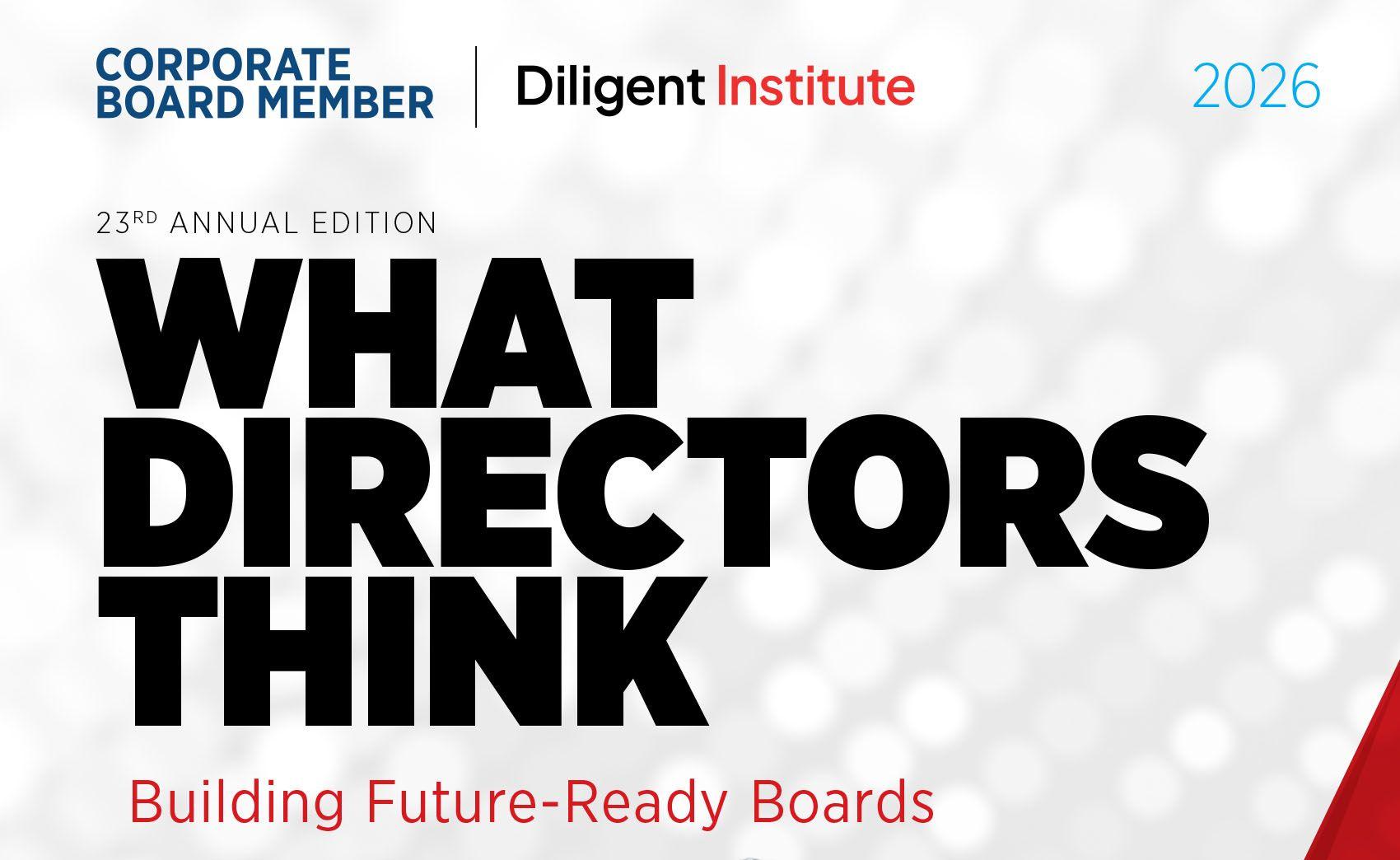
Kira Ciccarelli: Yeah, definitely. And there's the structural component, but then I also think there's the human capital component as well. We saw in our What Directors Think survey last year, I think it was the 2025 results, and that's an annual survey of US public company directors that we do.
Kira Ciccarelli: In partnership with corporate board member at Diligent Institute, we asked directors what they thought the biggest risks. Of incorporating AI were, and it was actually the top risk that they cited, was making sure that they had the right people in place. That came up even above things like data privacy risk, or the risk of hallucinatory information coming out of the AI systems that you're using.
Kira Ciccarelli: Not to say that those things weren't high up on the list, because I still think they are of, you know, a pretty big concern, but. I think you could already see the board thinking about how do we make sure that we're either upskilling the people that we currently have in some of the high profile roles in our organization, or how are we making sure that we're bringing the right people in to make sure that we can handle this transformation effectively?
Kira Ciccarelli: And then most recently in our director Confidence index, which is sort of a quarterly pulse survey that we do with corporate board member. The results, uh, just went live last week actually. We asked whether the board has intentionally recruited to address a specific capability or skills gap at the board level.
Kira Ciccarelli: AI or technology came up as like the third most frequently cited skills area, so it was below industry and financial, which, you know, things like that are always gonna be sort of top of the list for skills the boards recruiting for. AI and technology is definitely top of mind, even at the highest levels of the organization too.
Meghan Day: Very interesting. And that actually leads us to today's conversation, which is with James White, the former chair president, and CEO of Jamba, and the current chair of the board of the Honest Company. And James is all about culture and the importance of culture in particular through tough times.
Meghan Day: For me, that is going to be so important for organizations as we enter into this new era when you have to overhaul how your company works from top to bottom, the demands that are required for that it, I think foundationally is going to require a really strong cultural foundation.
Kira Ciccarelli: Absolutely. Let's give the interview a listen.
Meghan Day: Joining us on the Corporate Director Podcast today is James White. James is the former chair president and CEO of Jamba and chairperson of the Board of Directors of the Honest Company. He's also the author of Culture Design, how to Build a High Performing, resilient Organization With Purpose. James, welcome to the show,
James White: Meghan.
James White: I'm thrilled to be on with you today.
Meghan Day: Well, to kick us off, would you mind just doing a brief introduction of yourself to our audience? Tell us more about your career journey and a little bit on what you're focused on today.
James White: Uh, here, here's kind of my, uh, career, uh, journey. I'm a 30 year operating executive.
James White: I've spent time in the consumer products industry about 20 years. The Coca-Cola company, Nestle, Purina, and Gillette, and then spent another decade between retail and restaurants, between Safeway. And then I was CEO at Jama so's public company, CEO, for almost eight years. And then I've been in the boardroom for 20 plus years and, have logged probably 15,000 hours plus in the, in the boardroom.
James White: Chair of lead independent director seven times and have chaired all the, committees, except for audit.
Meghan Day: You led Jamba through a major transformation and now chair the Honest Companies Board. When you first step into a role where transformation or turnaround is clearly needed, what are some of the very first signals you look for to understand the real state of the culture in the business?
James White: I think the, the, the first place that I always start with really any, uh, new opportunity, at least as an operating executive, is I wanna really listen deeply to really all the key stakeholders. What I, one of the things we initiated when I showed up at Jamba, I wanted to talk to really the entire organization, in the most thoughtful way possible to see.
James White: What their take was on where the opportunities are. What I find is that the organization actually knows the things that need to be fixed. They know the things that work. And one of the simple processes that we always use is a start, stop, and continue piece of feedback. And then it's kind of the bonus question is what advice would you have, James or the CEO?
James White: And that really just incredible feedback from. The employee base, but I also went through the same process with all the key stakeholders, including, board members, suppliers, and then we had some, ways to talk to consumers, to, really see what problems our guests, the Java wanted us to solve for them.
Meghan Day: I think that perfectly tees up your work on culture, and I'd love to have you tell us a little bit more about your book in particular. Maybe what are some of the big takeaways you want leaders to walk away with?
James White: Our book is, culture Design. It was released, last fall. It hit the USA Today bestseller list In the, the book has a simple thesis.
James White: Companies have culture by design or default. And we firmly believe that the best companies are really intentional about the cultures that they build. The book we framed in really three pillars. One is knowing what matters, which is really all about really understanding the context in which the particular company operates and does business, and what the unique challenges are for that business.
James White: Doing what matters. How does the culture. To in terms of what the operating is, what are the rituals of the company, how do the value show up on a daily basis? And then from a business perspective, anything that matters, you measure it. So the final pillar is measuring what matters. And we give the readers various ways, both quantitative and qualitatively to think about.
James White: How to measure what matters. And the book also had a, a cross generational through line. My, my co-author of the book, my daughter Krista, is a millennial. So we balance the two perspectives that we both have about business and work throughout the book. And we have a mechanism that we used in the book we talked about with pullouts that hit were jameses.
James White: Notepad and Krista's notes app to kind of distinguish the generational lenses that we try to bring to the work. And one of the questions we commonly get is, tell me how you think about culture. So we interviewed a, a, a leader, Tony Wells, who's a, also a, a corporate director. He talks about. Culture being the operating system that companies run on.
James White: So that's one way to think about it. Danny Meyer, the restaurateur, talks about culture being all the things that we say we stand for, minus the things that we accept. So we try to give people just different ways to kind of think about culture, really practical to-dos out of each. We really had an interesting first five or six months as we have put this into the world, and having just the engagements with large and small companies, board directors, CEOs and C-suite executives and companies at large.
Meghan Day: Well, I love that multi-generational approach and certainly seems like you pulled in some great leaders to share their perspective. I'd love to maybe make some of these examples a little bit more concrete. Can you talk a little bit about one or two ways where clarifying or recentering on purpose changed the trajectory of a transformation effort, and what did that look like inside the organization and in particular, at the board and executive level?
James White: I'd, I'd make a really, a couple points that give some illustrative examples from the book. One leader, Timothy Escamilla, who is the CEO of Bolthouse. Fresh, has a simple way. As he was joining that organization, he says every one of his employees should understand what a good day's work looks like.
James White: So if you just think about that for any leader, any C-suite executive, just to be able to clarify for every person in the organization should understand what a good day's work looks like in the organization. So that's one illustrative example. We had other examples of leaders. We really focused on focused working their respective organizations through the change that would be required to move to stronger performance.
James White: Carla Verone, who's the CEO at the Honest Company, used a way to kind of work our organization through change using the movie inside Out. And the animated characters. If the audience is seen that movie, there's a thought bubble. And it really is meant to depict that everybody's going through change, but we're absorbing the change in slightly different ways.
James White: So she had a check in process with the organization to see where the leaders and where the organization was at any moment in time, kind of using the inside out. A bit of a metaphor, what's happening in your head? And they would check in. She would help bring meaning. And this is where the knowing what matters, kind of the context matters for the leaders to really be able to set the stage.
James White: And the point is, it's okay for us to be different places as long as we acknowledge it and then can move through the change. And she would do that periodically with her organization and now has ritualized. Inside Out movie. So in her year two, she took her entire support center organization, you know, a hundred or so people to see Inside Out too.
James White: And then by year three, she had moved to another set of rituals where now the third day after Labor Day, they, the organization kind of resets around culture and change each year, both individually and personally. And she actually brought one of the. Directors from the movie inside out to their corporate headquarters to have that discussion.
James White: But again, the best leaders have a way of bringing meaning to the change. They're asking organizations to go through and they, kind of guide them on the journey.
Meghan Day: Really interesting example, and I wanna maybe focus on maybe some of the tougher stuff that comes with, leading a turnaround portfolio changes, leadership shifts, restructuring.
Meghan Day: Those all require tough but important calls. How do you balance urgency, discipline in those decisions while still protecting the culture of an organization?
James White: I think the most critical thing is just really establishing strong communication practices in in ways. And I'll, I'll describe it maybe in two ways.
James White: I mean, boards that are hiring CEOs to lead them through a transformation of some sort, have to be really, really clear on what the remit is in, in terms of the executive. And then from support and oversight perspective, the, the board has to be, actively engaged among themselves in terms of. What the remit looks like, and then have good communication and oversight in the most thoughtful way with the CEO and the management team as she's leading the organization through the change.
James White: So that's one example, and that's not always easy to do, to have those engaging, tough discussions when there are really, really tough choices to be made from an operating executive. Call it. C perspective, they've gotta make sure that they've got really good communication with all their key stakeholders, both their board members, kind of in total.
James White: There's gotta be clear alignment with and across their leadership teams. And then they've gotta be really, really effective communicators into the organization and have various mechanisms to communicate town halls. Could be newsletters, could be one-on-one conversations, but C, communication and effective frequent communication is probably the hallmark of leading change, especially in tough situations.
James White: You wanna always over communicate.
Meghan Day: It's a great, I think, structural example and would love to talk a little bit more about some of the. Underlying systems that really do shape culture. You know, many companies say they want to be high performing and resilient, but don't necessarily design systems and incentives to truly support that.
Meghan Day: From your experience, what are some practices that most directly enable resilience and performance?
James White: I think there's a couple examples that I would share from the book. There was a couple executives that we interviewed for the book and they talk about. The distance between what we say we stand for and value in what we actually do.
James White: And one of the things that the best organizations and leaders do is they try to reduce the gap between what we say and what we do on a frequent basis. So they're having that discussion and where there is a gap. They build action plans around those and try to continue to re reduce the gap. It's a little bit like the Danny Meyer quote is, our culture is actually all the things we say we stand for, minus the things that we allow.
James White: You know, so we're always working to reduce the, say, do gap. Another example, we interviewed the CEO of 86-year-old supermarket chain. A regional, super regional supermarket chain Snooks. And he and his leadership team, Ty Snuck, is the CEO. They do a live 360 process to review their key projects and key initiatives, and they'll do a look back on those.
James White: But one of the other really important processes that they do a live 360 with each other. So if you can imagine an executive team with every leader, starting with the CEO, getting both positive and negative. Feedback, but it's a way to keep the team absolutely aligned. It's a way to have really strong engagement and it also builds trust.
James White: Kind of over time. We thought that was a unique practice. This lives 360 that the SNS team put in place. Another example was a lifestyle fitness company, bay Club, that CEO, and it's a company made up of lots of acquisitions. So each year they have a, a summit where they bring the top three or 400 leaders together and they actually take a hard look at the culture, the values, and the future strategy.
James White: And one of the things we thought was really unique because they acquire so many businesses, they've got a process where some of the acquired companies, those founders, they put them before the organization and it's their way of honoring the past as they move themselves. So they wanna learn respect kind of out of the past, but absolutely continue to point the organization to the future.
James White: We thought that was a really unique, ongoing process. And this is a leader in an organization in a very competitive industry, and they pilot lots of different ideas and they iterate. We talk about in the book, the Outliers are building superior organizations requires 10,000 iterations, and Matthew Stevens and the team at Bay Club are just a fantastic example of that iteration required by great companies and leaders as they build culture.
Meghan Day: Let's bring things up to the board level. Boards obviously do play a really important role in all of this, but boards are also asked to oversee transformation on, on multiple fronts, digital, strategic, cultural, and as we're seeing more and more often all at once. So in practice, what does effective board oversight look like in all of this, and how can, this is like the perennial question for board members.
Meghan Day: Avoid being too hands off or too deep in the weeds. What's the right balance?
James White: I think the, the, the way to think about it's the board has to establish its ways of working in the most collegial way to add value, you know, for the CEO and the management team. And for my way of thinking about it is somebody who's.
James White: Sat in the board chair seat. It starts foundationally with a strong board relationship with the CEO and then ultimately the management team and culture, even in the boardroom is really driven by the the practices. And you know, here are examples of some of the practices that I love. I sit on boards with CEOs that will do a monthly letter to kind of focus.
James White: The board around what matters most right now, and it's an update to keep alignment kind of in between board meetings. I sit on boards where the CEO, she puts a letter over the, the board materials for that particular meeting, focusing the the entire board on the places where there are two or three be the ways.
James White: Ly creating connections with various members of the management team From a mentor or support perspective, the best boards beyond the standard committees will really leverage the skillset of the board in ways that advance the, the, the work of the full board, especially in the time times that we sit in where there is just such a velocity of change.
James White: There is actually more ways for boards to constructively add value to the management team without being a burden. You know, one of my quotes as a board member is, most days I wanna look like help versus work to the management team. And there's a, you know, there's an art and a science to being more helpful and less burdensome and less work to the management team.
James White: But every board has a culture. The best of scenarios. The culture of the board is aligned with the culture of the company and it's really an ongoing set of work. And some of the tools that help boards get better are the annual review and kind of the board assessment.
James White: The board succession work and what the ongoing conversations look like on how do we onboard people. And probably the most challenging piece of work in any boardroom and any, any board culture is how do you offboard people like that's a difficult discussion that almost never happens in the boardroom.
James White: And how do board directors get constructive feedback on how and where they're adding value and also where they might have opportunities to improve. But really all those. Critical components of a strong board culture, and then there's obviously ways for the board to dispense of its oversight and fiduciary responsibilities.
James White: In, in terms of the, the great questions that they ask of the the CEO and the management team.
Meghan Day: So for directors that might be stepping into some transformation or turnaround work, joining a company that might really clearly need a reset, what are some questions that they could be asking management in those first, you know, 90 days?
James White: I just think, and let's frame it as someone stepping into a new board appointment at a company that might have a, a challenge. Even going back to the interview process for the board opportunity, I would wanna understand, you know, from my board colleagues and the CEO, what are the most important challenges right now for this organization?
James White: You know, why is this particular board assignment open and available that both C believe. Board colleague can add value. I'm a big believer in effectively onboarding directors in ways that they can add the right kind of value, really right out of the gate. The, the other things for the director, I think to think about is really to understand what's the longer term view.
James White: I, I, I like to think about what's the three to five year view for the organization. Which better prepares me to ask questions around, you know, what decisions will we hope we make that'll benefit us a year, two years, three years, five years from now? That's the place where the directors, really add the most value, ensuring that we're having the right conversations.
James White: To help the management team anticipate kind of future changes and trends. Again, given the velocity of change. There's just a significant amount of investment and time and work in even education for the directors to keep pace with the changes that we see, in this modern kind of governance environment.
Meghan Day: Some great recommendations. Well, James, before we wrap up, a couple of questions we ask all of our guests. The first is, what do you think will be the biggest difference between boardrooms today and 10 years from now?
James White: I think there's kind of two, two or three things that'll be really more pronounced.
James White: I think the leadership and thoughtfulness of culture in the boardroom. Will be even more important. Boards historically have been relatively static, kind of from my viewpoint, so I think you're gonna see the velocity of change create more change in the boardroom. I think the tenures will be shorter, kind of driven by pivots in the businesses, transitions of CEOs, and just the need for different skill sets.
James White: In the boardroom and I think AI will be a force multiplying impact on changes in and around the boardrooms. I think boards are gonna need to be more in how they leverage the advent of, of ai, both from a risk and an opportunity perspective. So that's gonna shape I think, the conversations in the boardroom.
James White: I think the onboarding and offboarding of directors moving forward, but I think culture will be really central to the future in the boardroom. I think the leadership and courage required will be at an even greater premium 'cause we'll be having more constructive and intense discussions as the change environment becomes more heightened.
Meghan Day: What was the last thing you read, watched, or listened to that made you think about governance in a new light?
James White: Really, for me it's, it's, it's been the really all the work that we've done pulling together this book on culture and we've started to have lots of conversations with directors in this space.
James White: And the, the way I would kind of sum up the point, the confluence of the conversations around. Culture and the acceleration of ai. One of the things that I firmly believe that boards and leaders are getting wrong with ai, they're kind of leaving the humans out of the conversation, and there's almost no thought to the, the cultural implications on how the humans and the people will be impacted as we adopt and accelerate the, the use of AI in the, in the boardroom.
Meghan Day: Last but not least. James, what is your current passion project?
James White: The thing that I'm really most focused on, in this moment is really having as many conversations as we can around the impacts that culture will have on good governance moving forward, and really, having conversations with as many board directors and leaders in as many forums.
James White: To really bring this conversation more to the forefront, and I'd invite, any of your listeners to feel free to reach out. I have a passion for good governance and building great companies, and I think that's gonna be rooted in the strength of our culture and the conversations the.
James White: Really positive and constructive conversations that we should be having in the boardroom.
Meghan Day: Couldn't agree more. And again, James, thank you so much for your time today and sharing your wisdom with us. Such an important topic.
James White: Thanks for hosting me and it's great to be with you and this really important audience.
Kira Ciccarelli: I was really struck by that comment he made sort of towards the beginning of the interview about the fact that companies either have culture by design or by default. I thought that was a really interesting way of looking at it, and I think it applies to things well beyond just company culture as well.
Kira Ciccarelli: If you're not intentional about it, then. Like whatever the default conditions are, what you're gonna be stuck with.
Meghan Day: Absolutely. And that, that leads me to think about all of the work that needs to be done with AI transfer transformation. In order to be successful, in order to, to lead through this, you have to have a clear vision and a clear,
Meghan Day: What things will look like in 6 12, 18 months, let alone sort of the 3, 5, 10 year horizon work that you know, most CEOs and boards are thinking through. So. Again, that intentionality around culture I think is really gonna be where we see the companies, I think that, that live or die through this over the next couple of years.
Kira Ciccarelli: Yeah, I mean it's, it's just such a backbone to everything else that your organization is trying to accomplish, and it's a foundational in a way that if you're not, you know, like tracking yourself to specific, we want our culture to look like X, Y, and Z, and we wanna try and lessen the gap between what we say we care about and what we're actually doing in practice.
Kira Ciccarelli: I think things are gonna come off the rails really quickly.
Meghan Day: Well, we hope you enjoyed this episode of the Corporate Director Podcast, the Voice of Modern Governance. And maybe we should just change the tagline to The Voice of Modern Governance and AI, or something to that effect. But we'd like to say a couple of special thank yous.
Meghan Day: First to James White, our Culture Guru for his wisdom. Podcasts producers, Kira Ciccarelli, Steve Clayton, and Laura Klein. Our sponsors, KPMG, Wilson Sonsini, and Meridian Compensation Partners, and most especially to Diligent. If you like our show, be sure to give us a rating on your podcast Player of Choice. You can also listen to our episodes and see more from Diligent Institute by going to diligent.com/resources.
Intro/Outro: You've been listening to the Corporate Director podcast to ensure that you never miss an episode, subscribe to the show in your favorite podcast player. If you'd like to learn more about corporate governance and tools to help directors do their job better, visit www.diligent.com. Thank you so much for listening.
Intro/Outro: Until next time.