
In this article

Good advisory board practices can separate a board that shapes company strategy from one that meets twice a year and produces little of value. An advisory board provides non-binding strategic guidance to management, fills knowledge gaps and builds governance credibility with investors.
Unlike a formal board of directors, advisors carry no fiduciary responsibility, but that informality can work in your favor. With the right structure, an advisory board accelerates decisions, expands networks and prepares leadership for the governance expectations that come with institutional capital or an IPO.
This guide covers:
Advisory boards offer what most growing companies can't develop internally at speed: specialized expertise, expanded networks and honest outside perspective. Members are chosen for specific knowledge, compensated at lower rates than formal directors and carry no legal liability.
That distinction shapes how meetings work. Because advisors aren't accountable to shareholders, sessions tend to be more candid, creating space where leadership can surface half-formed strategies and receive genuine pushback rather than hedged consensus.
Advisory boards also often "provide safe harbours for executives who may be able to test-drive options" before taking them to the board of directors, according to Ivey Business Journal.
However, despite the formalization of advice, advisory boards tend to be less formal and go with the flow of executives' needs. A CEO, for example, may feel more comfortable expressing a tentative or partly formed view before an advisory group whose purpose is to provide advice and feedback.
For growth-stage companies, advisory boards provide several strategic advantages:
Advisory boards take different forms depending on what a company needs. The most common include:
Most growth-stage companies start with a business advisory board, then expand the model as the company scales.
The most effective advisory boards are built with intention. Four principles consistently separate well-functioning advisory groups from boards that stall or drift.
Before identifying candidates, map the knowledge your company needs but doesn't yet have internally. This might be domain expertise in a new market, regulatory experience in a target jurisdiction or operational insight into scaling a specific function. The more specific this mapping is, the easier it becomes to evaluate candidates against actual needs rather than general impressiveness.
A leaner advisory board is a more functional one. A useful rule of thumb: aim for roughly half the number of members on your formal board, or three to five advisors for most growth-stage companies. Larger groups make scheduling difficult, reduce accountability and tend to produce less substantive discussion.
Advisors who mirror leadership’s existing views back aren’t serving the company. The ones worth recruiting have a track record of independent thinking and a willingness to raise the questions leadership would rather not examine.
Cold outreach works better than many founders expect, especially when the ask is specific. A message that explains the company's stage, the advisory board's purpose and precisely why that person's expertise is relevant will outperform a generic request for "advice."
Warm introductions through investors or existing advisors are valuable, but they shouldn't be the only channel. Sector-specific LinkedIn searches, alumni networks and industry conference speakers are all legitimate starting points.
Even though advisory boards are less formal than boards of directors, a written charter establishes clear expectations and prevents common disputes about scope, confidentiality and commitment. Legal counsel should be involved in drafting the charter, particularly around confidentiality and equity provisions.
A well-constructed charter typically covers:
Developing a charter before recruiting advisors sets a professional tone that attracts candidates with formal governance experience.
Compensation is one of the most consequential and least understood decisions in building an advisory board. It signals how seriously the company takes the advisory relationship, and a misaligned structure can lead to disengaged advisors or unexpected disputes. Getting it right early also affects the quality of advisors you can attract — senior operators with formal board experience will benchmark your offer against what they see elsewhere.
Equity vs. cash: For growth-stage companies, equity is the primary form of advisor compensation. Common structures include grants of 0.1% to 0.5% of fully diluted shares, depending on the advisor's seniority, the company's stage and the level of expected engagement.
A domain expert brought in for a specific knowledge gap typically sits at the lower end of that range. An advisor with an extensive network, deep sector expertise or prior board experience at a comparable company may justify the higher end. Cash retainers are less common at the early stage but become more standard as companies scale and advisors carry heavier commitments.
Vesting schedules: Advisory equity typically vests over one to two years, often with a three-month cliff. This structure aligns incentives with continued engagement rather than rewarding advisors for a single introduction or early meeting. Some companies use the FAST Agreement (Founder/Advisor Standard Template), a widely adopted framework developed by the Founder Institute that standardises equity grants and vesting terms. It gives both parties a shared reference point and reduces friction in the initial compensation conversation.
Meeting fees: Some companies supplement equity with per-meeting fees, particularly for advisors who take on a heavier workload or participate in working sessions beyond quarterly meetings.
Tiers: It's worth designing compensation with advisor tiers in mind from the start. A two-tier structure — where standard advisors receive a base equity grant and strategic advisors with higher engagement expectations receive more — avoids the awkwardness of retroactively differentiating between board members who joined on the same terms. It also makes future additions easier to position.
The cleaner the compensation structure is at the outset, the easier it is to adjust as the company's needs evolve. Document the terms clearly in the advisory agreement before work begins, and revisit them at each renewal.
How a meeting is structured determines whether advisors leave with clarity or leave with nothing. These four practices drive the most productive advisory sessions.
Every advisory board meeting should have a written agenda distributed at least one week in advance. The agenda should specify not just topics but the type of input expected for each one: information sharing, structured feedback or a specific decision.
Advisors can't provide useful input on a topic they haven't had time to think about. Sending relevant background materials alongside the agenda moves meetings directly into discussion rather than spending the first half on updates.
Advisory boards typically meet two to six times per year, with quarterly meetings representing the most popular frequency. The cadence of the meetings will be determined by your advisers' availability and how often you want their advice. Regardless of the frequency of these meetings, it’s crucial to keep your board abreast of your organization’s activities regularly.
The most common advisory board failure is spending the entire meeting updating advisors on what the company has done, then asking for general input. Advisors provide better counsel when presented with a defined challenge and a specific question. "What's your view on our current sales motion for the enterprise segment, given the objections we're encountering?" produces more useful output than "Here's where we are. Any thoughts?"
Advisory boards lose credibility quickly when their recommendations aren't tracked. Assign a meeting owner, document advice received and action items agreed, then share a summary within a few days of the meeting. When advisors see their input acted on, engagement deepens.
While every advisory board runs differently, the following structure works well for most growth-stage companies:
Send detailed briefing materials at least one week in advance, including specific questions you want advisors to address. This shifts meeting time toward discussion rather than catch-up.
Advisors who hear from you only at the quarterly meeting arrive without context. A brief monthly update, covering key metrics, a live challenge and a recent win, closes that gap before it undermines the next session.
"Board engagement, to me, comes down to two pillars: relationship building and setting your board members up for success," says April Van Epps, Chief of Staff. "It's about helping them get what they need and making it easy for them to connect with the mission of your organization."
Practical between-meeting practices include:
"You can't really have an engaged board if you're not creating a relationship of trust with the board members," says Chandu Vemuri, Executive Assistant. "It is teamwork, and building that relationship is crucial.
Explore how AI-powered governance helps growing companies run more effective meetings and build professional board infrastructure.

An advisory board built for one stage of growth will not automatically serve the next. Conducting a brief evaluation at least annually ensures the board continues to reflect the company's current strategic priorities and surfaces the signals that tell you when informal governance is no longer enough.
Evaluation questions worth asking:
Rotating members who are no longer contributing actively is not a sign of failure. Building sunset clauses into advisory terms, typically at the one or two-year mark, makes this process less awkward and creates a natural renewal cycle. Regular evaluation also builds the habit of honest governance assessment, which formal boards will expect from day one.
For many growth-stage companies, that habit is what makes the transition to formal governance manageable. The shift typically becomes necessary when the company raises institutional capital, approaches an IPO or reaches a level of operational complexity that warrants genuine oversight rather than advice.
At that point, investors expect a formal board with fiduciary accountability, established committees and independent directors. Advisors who have been well-managed through a structured board process are often the first candidates for those seats, though the criteria for formal directorship differ materially from advisory membership.
According to the Transaction Readiness report by Diligent Institute, Wilson Sonsini, NetSuite, the CFO Alliance and the CFO Leadership Council, 31% of companies identify board alignment and communication as a challenge to successful transactions. Building those disciplines through a well-run advisory board reduces the gap companies need to close when formal governance becomes a requirement.
Advisory boards stall when advisors lack the materials, secure access and structured communication they need to contribute. Governance platforms built for board management address those gaps directly.
"The board fundamentally has to trust management," says Inna Barmash, chief legal officer and corporate secretary. "Trust starts with communication. Communication is successful when it's proactive, when it anticipates and addresses board members' concerns, and speaks to their experience from other boards and the organization."
Diligent Boards provides the platform infrastructure that supports professional advisory board management at scale. Key capabilities include:
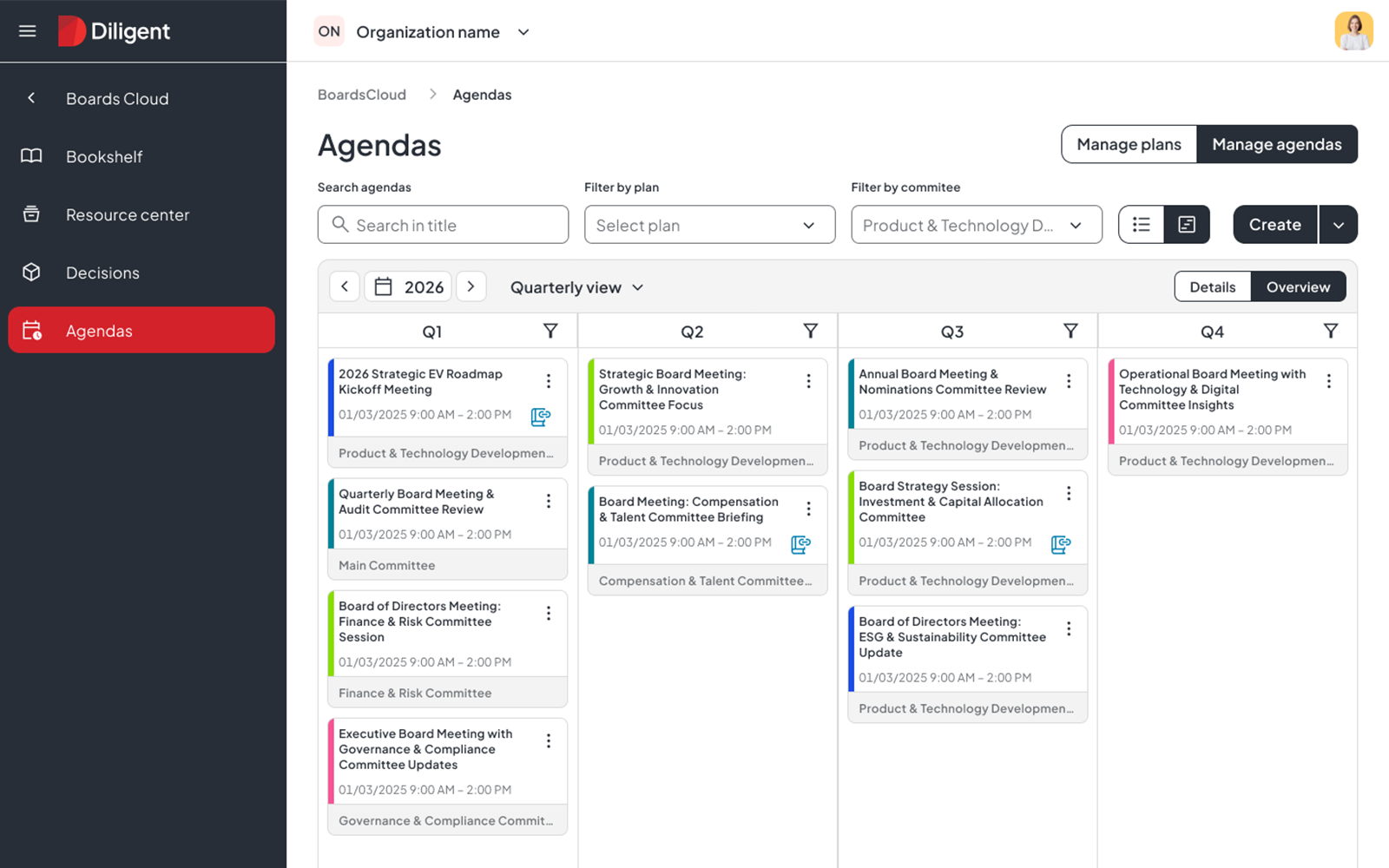
Diligent supports formal board operations, audit committee management and IPO preparation on the same system, so governance transitions don’t also require a technology migration. Learn more about running a best-in-class board meeting or explore the fundamentals of board governance best practices to see how governance infrastructure evolves as your company scales.
Effective advisory boards combine clear composition principles, structured meetings, disciplined between-meeting communication and the right governance infrastructure. The difference between a board that meets and one that drives real strategic value comes down to execution: how consistently preparation standards are maintained, how rigorously outcomes are tracked and how well advisors are kept in the loop between sessions.
For the founder or chief of staff who owns this process, the operational demands are real. Briefing materials need to reach advisors early enough for genuine preparation, sensitive information needs to stay off consumer messaging tools and every session needs a documented outcome that advisors can see acted on. When those elements slip, engagement follows — and an advisory board that stops engaging stops being useful.
The practices in this guide give advisory boards the structure to function at a high level. The right platform handles the rest: automating material preparation, securing communications and keeping every advisor working from the same source of truth as your company scales toward formal governance.
Schedule a demo to see how Diligent Boards delivers AI-enhanced meeting management, secure collaboration and governance infrastructure that grows with your company.
An advisory board provides non-binding strategic guidance to management, typically from external experts who bring specific domain knowledge, networks or sector experience. It differs from a formal board of directors in that members carry no fiduciary responsibility, hold no voting rights and are not legally accountable to shareholders. For growth-stage companies, advisory boards are particularly valuable for filling expertise gaps and building governance credibility with investors.
An advisory board charter should cover the board's purpose and scope, meeting frequency and attendance expectations, term lengths and renewal terms, compensation structure including equity vesting schedules, confidentiality requirements, conflict-of-interest provisions and IP ownership. Working with legal counsel to draft the charter is advisable, given the sensitivity of information advisors will access.
Most advisory boards meet two to six times per year, with quarterly meetings representing the most common cadence. The right frequency depends on the company's growth stage, the complexity of the challenges advisors are being asked to address and the availability of members. Consistency matters more than frequency. Irregular meetings signal to advisors that the board isn't a genuine priority.
Keeping advisors engaged requires structured communication between meetings, not just at meetings. Monthly updates covering key metrics, current challenges and notable wins maintain the context advisors need to contribute substantively. Reaching out individually when a specific advisor’s expertise is directly relevant to a current decision also deepens engagement. Compensation aligned with contribution, such as equity with appropriate vesting, creates further incentive for sustained involvement.
The transition typically becomes necessary when a company raises institutional capital, approaches an IPO or reaches a level of operational complexity that warrants fiduciary oversight. Investors at Series B and beyond generally expect a formal board with independent directors, established committees and clear accountability structures. Advisory boards prepare leadership for this transition by building the meeting disciplines and governance habits that formal boards require.
See how Diligent Boards helps growing companies manage advisory and formal boards from a single platform. Book a demo today and build governance infrastructure that scales with your company.