
Company Secretaries and General Counsels must soon guide their boards through a seismic change: Mandatory identity verification under the Economic Crime and Corporate Transparency Act (ECCTA). This new compliance requirement, beginning 18 November 2025, isn’t just a box-tick exercise — it demands board education, proactive engagement, strategic decisions about how and when verification is undertaken, and the best verification route for each U.K. entity.
This article breaks down the two official verification routes, explains who needs to act and when, and offers practical guidance to help Company Secretaries and General Counsel – particularly those based overseas - choose the best approach for their board.
Under ECCTA, identity verification becomes mandatory for all company directors, Persons with Significant Control (PSCs) and LLP members. Directors must verify their identity and provide their IDV code in their company’s confirmation statement date, which will fall within a rolling period starting 18 November 2025 and ending in November 2026. PSCs must verify their identities within a defined period, depending on their specific circumstances.
If a director’s identity isn’t verified, the company won’t be able to file its confirmation statement with Companies House — leaving it non-compliant and potentially unable to operate. Failure to verify is also a criminal offence, punishable by fines and civil penalties issued by the Registrar of Companies. Where a PSC fails to verify their identity, they will be committing a criminal offence, but the company itself won’t be liable for sanctions.
From Spring/Summer 2026, secretarial and legal team members must also be verified to file documents. Without verification, they won’t be able to file with Companies House, putting group compliance at risk. Early action is advisable so teams can secure their personal codes and establish robust processes.
There are two official routes to identity verification under ECCTA. Each option has its own strengths and limitations — and the right choice depends on your board’s composition, identity documentation and risk profile. Here’s how each route works — and what to consider:
This route is designed for speed and simplicity. It’s ideal for UK-based individuals with biometric ID and complete the process online, allowing them to verify directly through GOV.UK and use their code across multiple roles and filings.
Strengths
Limitations
ACSPs offer a more flexible, supported route — particularly useful for boards with overseas members, complex structures or individuals who don’t meet One Login criteria. These providers (e.g. accountants, law firms, formation agents) handle verification on your behalf, but charge a fee and apply their own risk assessments. Read this blog post for a deeper dive into ACSPs and presenter ID requirements.
Strengths
Limitations
Mandatory identity verification starts 18 Nov. Learn how Diligent helps Company Secretaries and GCs simplify compliance and avoid last-minute filing risks.

Choosing the right route isn’t just about eligibility — it's about understanding your board’s makeup, habits and preferences. A thoughtful approach will help governance teams avoid delays, reduce friction and build confidence in the process.
Here are 4 practical steps to help you choose the best route for your board:
The identity verification requirement comes into effect on 18 November 2025 — but the timeline for action depends on your company’s confirmation statement date and the roles involved. The mandatory period is triggered either by the company’s next confirmation statement or by the need to appoint a new director or PSC.
Planning ahead will help avoid last-minute issues and ensure a smooth transition.
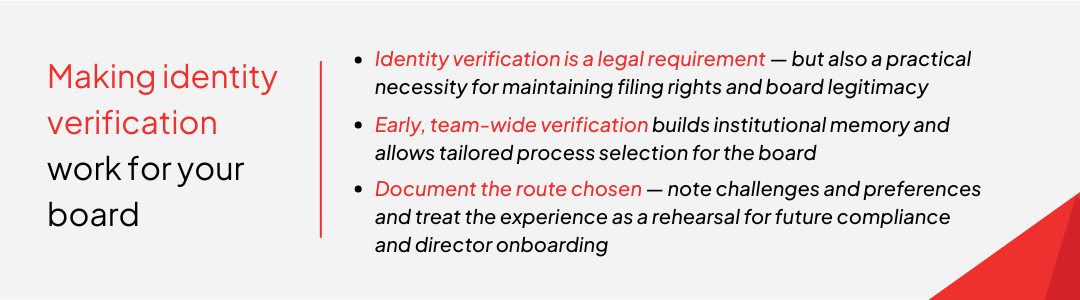
Identity verification isn’t just a one-off task — it’s something governance teams will need to manage continuously as directors join, leave or change roles. The most effective boards will treat IDV as part of their governance rhythm, embedding it into onboarding, offboarding and annual routines.
Here are a few ways to make that happen:
✅ Add IDV to your onboarding checklist for new directors and PSCs
✅ Include verification status in board succession planning
✅ Build internal guidance to support future filings and transitions
✅ Capture lessons from early pilots to improve future processes
By treating IDV as part of good governance — not just compliance — Company Secretaries and General Counsels can build confidence across the board and ensure long-term continuity.
Ready to simplify ECCTA compliance? Request a demo of Diligent Entities.