
menu
menu
ESG is a practice in which investors consider a company’s environmental, social and corporate governance impact when making investment decisions. This makes ESG not only a priority for investors but also an imperative for corporations that want to both attract more shareholders and satisfy those they already have.
Here’s what corporations and their boards need to know, given that ESG investing is here to stay. We'll cover:
ESG meaning: “Environmental, social, and governance,” which, together, represent a more stakeholder-centric business approach. So, what is ESG? It is a framework used to assess the sustainability and ethical impact of a company's operations and practices. It is set on the principle that the environment is only one factor in determining an organization’s commitment to sustainability.
Companies that adhere to environmental, social and governance standards agree to conduct themselves ethically in those three areas. This commitment can draw on various strategies, tactics and ESG solutions. As ESG increasingly becomes the top of directors' minds, it’s essential to consider the global nuances that drive focus region by region.
To better understand the meaning of ESG, an excellent first step is to identify the factors within the environmental, social and governance categories.
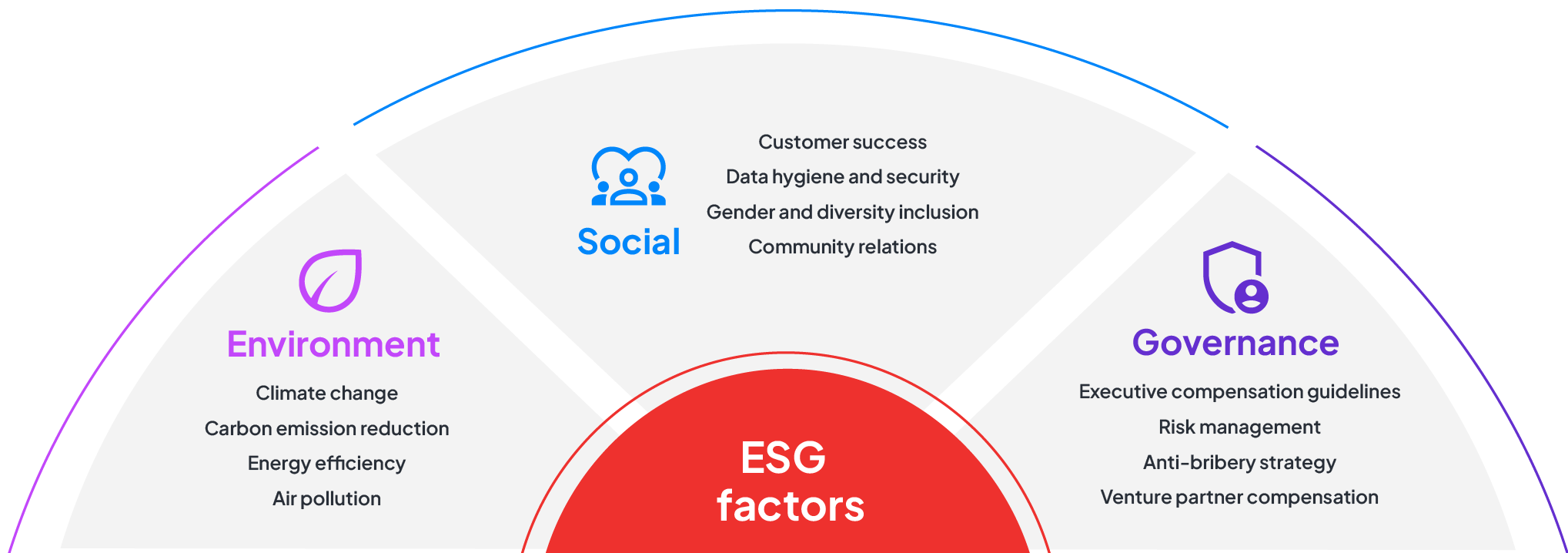
Some common ESG factor examples include:
Preservation of our natural world concerning factors like:
Consideration of humans and our interdependencies:
Logistics and defined processes for running a business or organization:
ESG movement meaning: Considering the impact of business decisions on people and the planet alongside profits.
More specifically, the ESG movement reaches back to the 1960s, when investors began to prize social responsibility. Many investors of the time, for example, refused to invest in companies with ties to South African apartheid.
As deep as ESG’s roots run, the concept as we know it took hold in the mid-2000s and was codified in a 2004 report from the UN. Then and now, ESG is based on the idea that corporations have the power — and the responsibility — to effect change.
ESG is critical on many levels, including:
The anti-ESG movement represents a growing backlash against using ESG factors in business and investing. Critics argue that ESG considerations can politicize corporate decision-making or impose new ideologies on companies and investors. Many — even directors — also feel ESG’s benefits can be hard to prove.
For example, while the vast majority of board directors said diversity brought unique perspectives to the board and improved board culture, only 40% could tie it to enhanced company performance. In this vein, ESG opponents often point to several concerns:
ESG risks are manifold and increasing: climate change, diversity, cybersecurity risk, reputational risk, and the list goes on.
“If you have a company where most of your customers are based in one particular part of the world and then that particular part of the world has a major incident, whether it's geopolitical or environmental or whatever it is, that's going to be a disruption to your business,” says Dottie Schindlinger, executive director of the Diligent Institute.
Meanwhile, pressure is intensifying from investors and other stakeholders to identify and mitigate ESG risks in a timely, effective fashion.
Boards, in their oversight role, need to be leaders in ESG and risk management, yet they often struggle to get their arms around this subject, even with clear risk scores, in large part because risks are spread across three different categories.
Environmental risk includes mitigation and compliance efforts in areas like climate change, conservation and environmental protection. For example, what is a company's carbon footprint, and how does it ensure waste doesn't contaminate the soil, air and groundwater?
Today’s droughts, food insecurity and rising temperatures are having a domino effect on the environment, resulting in new regulations and new risk factors for investors. Over the long term, displacement from climate crises will change the demographic makeup of regions and nations, not to mention how consumers and employees live their lives.
Social criteria encompass a company's business relationships with employees, suppliers, partners, shareholders, and the overall community. This could involve wage and labor issues, philanthropy, workplace safety, diversity, equity and inclusion.
“We're seeing literal spots on planet Earth also become geopolitical hotspots on planet Earth because things like the scarcity of resources, the scarcity of water, those things begin to exacerbate geopolitical tensions,” says Schindlinger. “Just kind of look at the map and figure out where we are and where might there be a choke point if that was knocked out, what would that do to our business?”
More specifically, PwC’s Annual Corporate Directors’ Survey found that the majority of directors surveyed are concerned about the impact of political divisiveness in the U.S., the lack of a cohesive U.S. immigration policy and the uncomfortable reality that their boards haven’t discussed these critical social issues.
Governance risks are those that could impact how a company is run, from board practices to transparency in shareholder communications to the ethics of its leadership. While risks have become increasingly interconnected, boards should focus on material ESG risks: the issues that most impact their specific company most in terms of cost, risk and growth.
Boards also should keep in mind that different aspects of ESG may be more relevant to their industry than others. For example, a mining company may pay more attention to environmental issues than an app development company would.
A report by AICPA & CIMA and North Carolina State University’s Enterprise Risk Management (ERM) Initiative found that 66% of global executives feel the volume and complexity of risks are increasing.
These risks can be particularly daunting for small and medium-sized enterprises (SME) without a robust ESG program. However, organizations just starting their ESG journey can ground their approach in strong risk management using the power of AI. Integrating AI in risk management can analyze vast amounts of data to uncover hidden patterns and emerging risks, so SMEs can do more with ESG with fewer resources.
Accelerate your progress toward risk management mastery with Diligent AI Risk Essentials >
Though ESG is a priority for many, it’s also controversial. Many lawmakers believe ESG is a political calling card that detracts from generating real shareholder returns. This backlash, though, is largely tied to ESG myths that are easily misunderstood — but are even easier to debunk.
A few of these myths include:
While there are ESG proponents and detractors aplenty, the reality is that ESG has evolved significantly since it first came to the fore. Why? Companies’ and regulators’ understanding of ESG has shifted, as have investor expectations and the very ESG landscape itself.
“This is a topic that’s here to stay,” says Sunni Chauhan, leadership advisory for board and CEO practice at Spencer Stuart. “The data that supports that is that 96% of directors expected a continued or stronger focus on ESG over the next five years. And there’s no surprise that DEI and climate change top the list. While the corporate world has been defined by flux, the reality is that very few companies are backing away from ESG ambitions.”
Over the years, ESG has adapted to:
For investors, environmental, social and governance considerations are a growing priority. As our environment changes, new risk factors are cropping up for investors, and new regulations are being enacted to mitigate the effects of environmental damage.
All of this has resulted in what we now call ESG investing. Here we'll clarify:
ESG investing definition: Selecting investments based on the company’s policies and practices regarding environmental, social and governance issues.
![For investors, ESG is broadly a checklist to say yes, you know the companies in our portfolio […] have these factors, and that should lead to better returns. - Quote from Ezekiel Ward, the founder of North Star Compliance Limited](https://cdn.sanity.io/images/33u1mixi/production-2026/881931a41f0ce88ef249ed495089b8cea9a5f47b-1940x696.png?w=3840&q=90&auto=format&fit=max)
Droughts, food insecurity, and rising temperatures have a domino effect on the environment that impacts multiple sectors. As a result, investors want to address those new risks and take action to prevent them. ESG investing is their solution.
ESG investing also signals a changing of the guard. Today’s generation of investors is on the receiving end of a massive wealth transfer from the Boomer generation, as much as $84.4 trillion by 2045, according to Cerulli Associates.
$50 trillion of that money could go into ESG assets in the next couple of decades, according to a Bloomberg estimate regarding ESG investing, accounting for more than a third of the projected $140.5 trillion in total global assets under management.
ESG investment started in the 1960s. While certain ethical concerns have changed, the principle of sustainable investing remains the same. More and more investors are adopting ESG criteria, evaluating their potential investments with an emphasis on how effectively corporations navigate people and planet, not just profit.
According to a report by PWC, the practice of ESG investing has grown over the last few years. The report states that the ESG asset pool will continue to grow rapidly and become essential in the investment process in the coming years.
The growth of ESG investing can be boiled down to three reasons, according to financial firm MSCI:
Both ESG investing and impact investing are purpose-driven, but the difference has to do with the investors’ priorities. ESG investors consider the ethical implications of a corporation’s environmental, social and governance policies, while impact investors are more concerned with driving social change through their investment.
ESG investing is good for both the world around us and the investors’ return. People used to believe that ESG investments were a sacrifice — an investment more morally than economically motivated. Today, that isn’t necessarily true.
In fact, in 2018, global sustainable investing assets were approximately $29.86 trillion; by 2034, ESG investing is expected to reach $167.49 trillion.
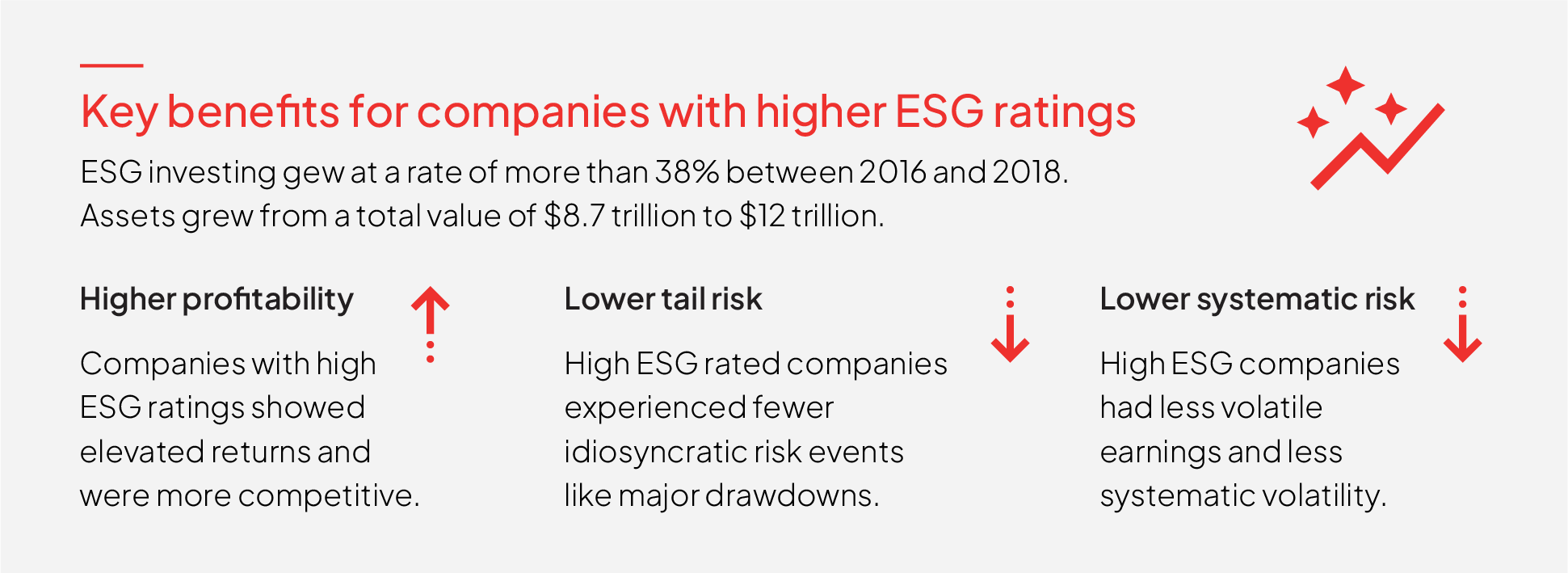
Some studies have even suggested that companies with good ESG practices have lower capital costs and volatility. They also displayed lower instances of bribery, fraud, and corruption over time. These results suggest that, in the long run, ESG investments are more stable and can even outperform other companies.
ESG investing can perform as well as — or even better than — traditional investing, particularly over the long term. Answering this question has been the subject of extensive research.
A 2021 meta-analysis by New York University’s Stern Center for Sustainable Business reviewed over 1,000 research papers from 2015 to 2020. The findings showed:
ESG investing is important in many ways. 80% of the world’s largest companies have reported exposure to climate change-related risks, while climate-related events could cost those businesses $1.2 trillion annually by the 2050s. ESG is an important way to insulate against those risks.
ESG investing is also financially important. In a recent study, MSCI investigated the ties between ESG investments and the stock market, to see if there were any financially significant effects. The study used a three-channel model to look at how ESG data embedded in stocks gets transferred to the equity market.
The study found that, after examining idiosyncratic and systematic risk profiles for the companies involved in the study, ESG affected many of those companies’ valuations and performance. Companies with higher ESG ratings showed:
ESG investing can also cut risk in emerging markets. There is research to suggest that companies adhering to ESG principles have a lower chance of tail risk — the risk of unlikely events that lead to catastrophic damage.
ESG investing works by giving equal weight to a company’s finances and its social impact. In ESG investing, an investor will evaluate how a corporation operates, how it relates to its community and how it impacts the environment to inform their investment decision.
If the corporation is found lacking in any of those areas, ESG investors are likely to move on.
ESG integration is the process of incorporating ESG risks and opportunities alongside financial metrics throughout the investment lifecycle. An investor may achieve this through either negative screening — the practice of excluding certain industries — or impact investing. In either case, the goal is to enhance the portfolio’s resilience and performance in the face of evolving environmental and social risks.
Here’s how an investor does it:
Like traditional investing, ESG investors can invest in a variety of different products with the help of a robo-advisor or broker. These include:
The ESG investing rule is a rule from the Department of Labor related to retirement funds. It allows companies that administer retirement plans covered by the Employee Retirement Income Security Act to consider ESG criteria in their investments.
This doesn’t change the fiduciary duty companies have to protect their investors’ assets, but it does expand the asset classes they can consider, signaling, once again, that the emphasis on ESG isn’t likely to go away.
Though ESG ties back to investing, investors have also swayed corporations to take ESG issues seriously. This has shaped not only the meaning of ESG for corporates and conversations in the boardroom but also activities throughout the entire corporate value chain.
Since the threats facing society will likely continue to loom, ESG will also remain a critical focus for investors in the coming decades. That makes corporate ESG an equally significant topic for corporations and their boards.
In business, ESG equates to a business opportunity. Corporations can take a strong stance on ESG issues and signal to investors that they care about both generating reliable returns and mitigating their environmental and social impact.
Because not every corporation has adopted ESG equally, it’s also an opportunity for corporations to differentiate themselves. Those who take a systematic and strategic approach to ESG can carve out a reputation as ESG leaders in their industry — the kind of organizations young investors want to support.
![When it comes to ESG, corporates are looking at this through the lens of business opportunities; […] new markets that they can open up and sell to, cost reductions, and also integrated risk management. - Quote by Ezekiel Ward, founder of North Star Compliance Ltd.](https://cdn.sanity.io/images/33u1mixi/production-2026/399bea9666aed80a86fbd978db10f63ddc791786-1940x696.png?w=3840&q=90&auto=format&fit=max)
The boardroom is full of acronyms. While the ESG acronym can feel like another to add to the pile, it’s distinct from other acronyms that might circulate — all of which are important in their own way. Some of the acronyms to know are:
The relationship between ESG and the board of directors is still being defined. However, driving ESG buy-in from the top is essential.
“It’s been my experience that the very best results are achieved when every single person in the organization understands the why. And what I mean by that is, what are the motivations for setting the goal or goals in the first place? Both in terms of how they tie into the organization’s overarching purpose, the risks they’re trying to mitigate, and the opportunities that come with that,” says Lisa Bougie, an independent board director.
As it stands:
Many corporations struggle to envision ESG in practice. But ESG strategies are more widespread than you might think. The following are some common boardroom topics that are also prime ESG examples:
Environmental examples:
Social examples:
Governance examples:
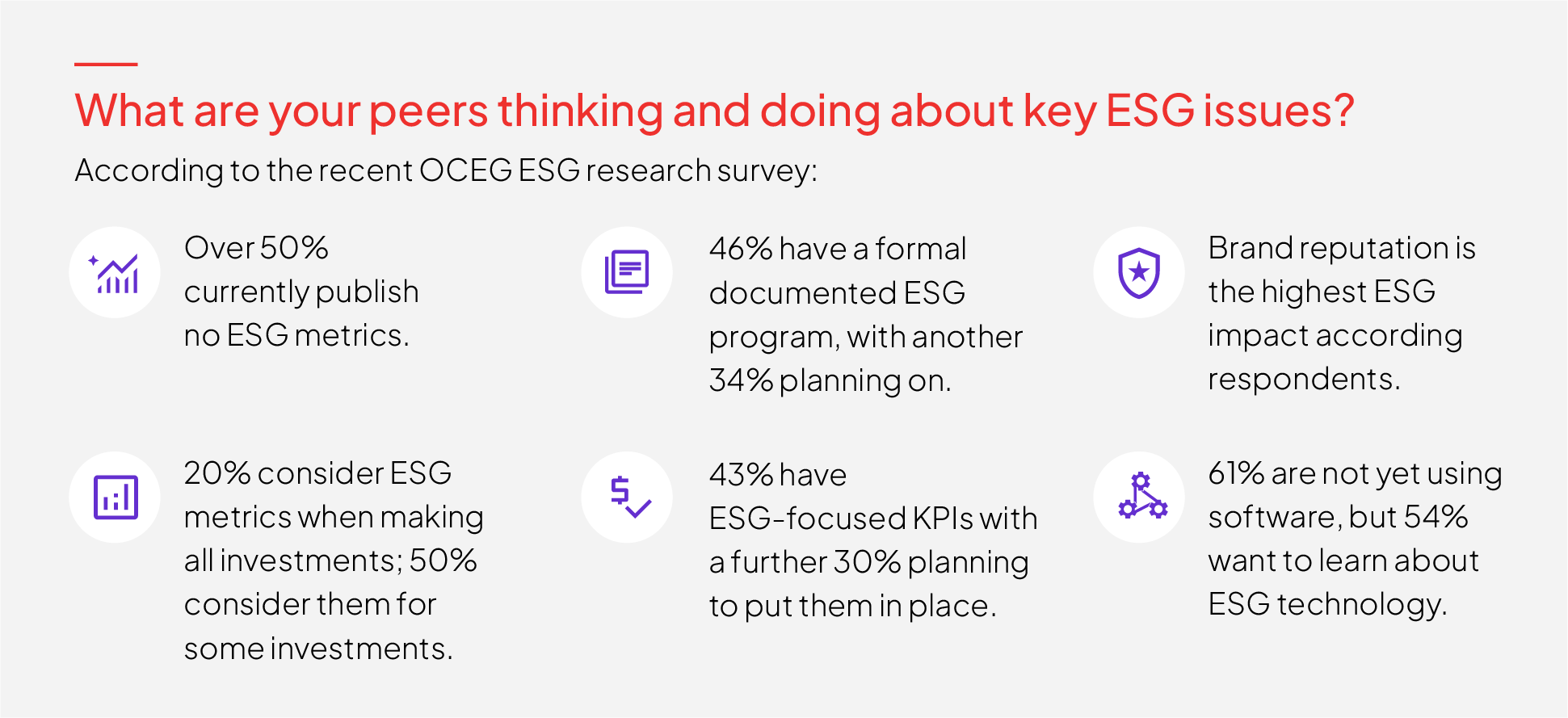
According to the recent research from Diligent Institute and Spencer Stuart, corporations are currently at the following stages of implementing, documenting and disclosing ESG risks:
ESG metrics:
ESG disclosures:
ESG risks:
ESG technology:
As ESG reporting becomes more central to corporate strategy and investor decision-making, regulators and other governing bodies have attempted to implement standardized and comparable disclosures. Here’s a closer look at some of the most widely used:
ESG frameworks are about disclosure, but ESG initiatives are about action. Companies across industries have launched ESG initiatives to align business practices with environmental sustainability, social responsibility and strong governance — all under the umbrella of their corporate strategy and ESG framework of choice.
Companies that prioritize the “E” in ESG often invest in climate and sustainability solutions that go further than regulators require. These efforts commonly include:
Companies may also take steps to further equity, inclusion and community accountability. Key initiatives include:
Strong governance is the foundation of effective ESG performance, which is why companies are strengthening accountability and oversight through:
The road to effective ESG initiatives isn’t always easy, largely because they're iterative. ESG success isn’t just adding a recycling program or offsetting your carbon emissions. It’s that, plus a systematic approach to making your operations sustainable — and your sustainability defensible. To do that, modern boards need to:
ESG strategies have traditionally been reactive, responding to stakeholder and regulator expectations rather than a proactive view of the business landscape. Tools like Diligent AI are shifting this approach, analyzing massive data sets to identify material risks and opportunities and fundamentally changing how organizations approach ESG.
Here’s how:
ESG stands for environmental, social and governance. It's a framework used to evaluate how companies manage risks and opportunities related to environmental stewardship, social responsibility, and corporate governance. Investors and stakeholders use ESG criteria to assess a company's long-term sustainability and ethical impact, influencing investment decisions and corporate strategies.
ESG reporting involves the disclosure of data covering a company's operations in three areas: environmental, social and governance. This transparency allows stakeholders to understand a company's ESG practices and performance, aiding in informed decision-making. Effective ESG reporting can enhance a company's reputation, attract investors and ensure compliance with regulatory requirements.
Integrating ESG considerations into supply chain management helps companies mitigate risks, improve sustainability and meet stakeholder expectations. By assessing suppliers on ESG criteria, businesses can ensure ethical practices, reduce environmental impact and enhance overall supply chain resilience.
Corporate social responsibility (CSR) refers to voluntary initiatives by companies to contribute positively to society and the environment. ESG, on the other hand, involves measurable criteria used by investors to assess a company's performance in environmental, social and governance areas. While CSR is often internally focused, ESG is data-driven and externally evaluated.
In April 2025, President Trump issued an executive order titled "Protecting American Energy from State Overreach," aiming to remove state-imposed legal restrictions related to climate change and promote domestic energy production.
Part of the president’s broader push for deregulation, the order aims to reduce compliance costs and spur economic growth. While many directors see opportunity in the greater operational freedom, it also raises the importance of robust ESG mechanisms that hold up independent of regulatory mandates and reporting obligations.
One significant limitation of the ESG label is the lack of standardized scoring methodologies. Different rating agencies may assess ESG factors differently, leading to inconsistencies and potential confusion among investors. Additionally, ESG scores may focus more on internal processes rather than the actual impact of a company's products or services.
ESG investing involves evaluating companies based on environmental, social and governance criteria to mitigate risks and identify opportunities. Impact investing goes a step further by actively seeking investments that generate measurable positive social or environmental outcomes alongside financial returns.
The iShares ESG Aware MSCI Emerging Markets ETF has sparked debates regarding its ESG criteria and the inclusion of certain companies. Critics argue that some holdings may not align with ESG principles, raising questions about the fund's screening processes and the broader challenges of ESG investing in emerging markets.
ESG stands for environmental, social and governance. These three pillars are used to evaluate a company's operations and performance on sustainability and ethical issues.
As of March 2025, ESG investing in the US is experiencing shifts due to regulatory changes and political dynamics. Some states have implemented rules limiting ESG investments, while others continue to promote them. Investors are increasingly scrutinizing ESG disclosures, and there's a growing emphasis on standardized reporting frameworks to enhance transparency and comparability.
While ESG investing focuses on evaluating companies based on environmental, social, and governance criteria, sustainable investing encompasses a broader approach that includes ESG factors and considers long-term environmental and societal impacts. Sustainable investing aims to support companies that contribute positively to sustainability goals.
In corporate strategy, ESG refers to integrating environmental, social, and governance considerations into business operations and decision-making processes. This integration helps companies manage risks, identify opportunities, and align with stakeholder expectations, ultimately contributing to long-term value creation.
Several companies have demonstrated successful ESG investments. For instance, Microsoft has committed to becoming carbon-negative by 2030, and Accenture has implemented extensive diversity and inclusion programs. These initiatives have not only enhanced their reputations but also contributed to financial performance.
Microsoft has seen a reduced carbon footprint and increased energy efficiency, plus a reported $10 billion increase in sales due to ESG initiatives. Meanwhile, Accenture reported a 20% increase in employee engagement, a 17% increase in customer satisfaction and a 20% increase in shareholder value.
The 'G' in ESG stands for governance. It pertains to a company's leadership, executive pay, audits, internal controls and shareholder rights. Strong governance practices ensure accountability and transparency, which are crucial for long-term success.
'Green' typically refers to initiatives focused solely on environmental aspects, such as reducing carbon emissions or conserving resources. ESG encompasses a broader spectrum, including environmental, social and governance factors, providing a more comprehensive assessment of a company's overall impact and sustainability.
The three primary types of ESG investing are:
ESG performance is measured using various metrics and frameworks that assess a company's environmental impact, social responsibility and governance practices. These may include carbon footprint, labor practices, board diversity and compliance with regulations. Rating agencies and investors use this data to evaluate and compare companies' ESG performance.
ESG risks refer to potential negative impacts on a company arising from environmental, social or governance issues. These risks can affect a company's reputation, legal standing and financial performance. For example, environmental disasters, labor disputes or governance scandals can lead to significant financial losses and damage to stakeholder trust.
Artificial intelligence (AI) enhances ESG strategy and reporting by automating data collection, analysis and reporting processes. AI can identify patterns, predict risks and provide insights into ESG performance, enabling companies to make informed decisions and improve transparency.
Industries such as energy, manufacturing and finance are significantly impacted by ESG factors due to their environmental footprints, social responsibilities and regulatory requirements. Companies in these sectors must proactively manage ESG risks and opportunities to maintain competitiveness and comply with stakeholder expectations.